Tag: Gettysburg field hospitals
-
The Daniel Lady Farm: Bloody Floors, Carvings, and Ghosts

The Daniel Lady Farm near Gettysburg, Pennsylvania, is known both for its pivotal Civil War history and for ghostly legends. John Forney, owner of the land of Iverson’s pits, could relate well to the Ladys. But more than just the dead in the fields, the house and barn have permanent reminders of the war (similar…
-
Sarah Kime, the Jacob Kime Farm, and William McLeod

In the story of William McLeod, we saw the importance of black man Moses, who was critical in bringing McLeod home. Another key figure in the story has not been mentioned yet. In 1863, Sarah Kime was 11 years old, the oldest daughter and second oldest child of Jacob and Sarah Bucher Kime. She had…
-
Lt. Col. William McLeod and the 7-Year Wake

If you squint hard enough at the story of William McLeod and his brother-in-law John Prescott, you can almost see the Tarleton twins from Margaret Mitchell’s Gone With the Wind. Proud Georgia boys cut down in the prime of life in defense of their homeland. Or something like that. At least, that’s how the tales…
-
Dr. Charles P. Krauth: Lutheran Theologian and College President
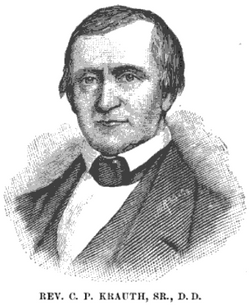
When Charles P. Krauth yielded the presidency of Pennsylvania College to Reverend Henry Louis Baugher in 1850, he had been at the helm for sixteen years. He was 53 years old, and after a lifetime of ecclesiastical service, you might assume that he was ready to retire. But Dr. Krauth did not retire—he stayed on…
-
Reverend Henry Louis Baugher: The Force Behind Christ’s Church (Lutheran)

That teacher that won’t cancel classes during a blizzard or a major national event, that ensures you always get the homework assignment . . . that was Henry Louis Baugher. If Christ’s Church (Lutheran) was the physical object that brought Gettysburg College, the Lutheran Theological Seminary, and religious worship together, the force behind them was…
-
The Role of Christ’s Church Before, During, and After the Battle of Gettysburg

When considering its history with the Battle of Gettysburg, Christ’s Church (now known as Christ Evangelical Lutheran Church) is best remembered for the killing of clergyman Horatio Stockton Howell (more on that below) and the sheltering of Ole Liz Butler, a black washerwoman who escaped Confederate cavalry and hid until the battle concluded. The Church…
-
Life and Death on the Farm of John and Elizabeth Wible

The lives of Reverend John Wible and his wife, Elizabeth Wible (Stallsmith), appear to have passed without generating a lot of notice. The reverend worked at the Christ’s Lutheran Church (which played a prominent role in the battle). Elizabeth was from a long-running family in the area. They had no children. They turn up in…
-
The Interactive Gettysburg Map
This interactive Gettysburg map marks the beginning of a larger project to chart the civilian landscape of Gettysburg in new ways. What you see here is Layer One, focused on Confederate burials drawn from Greg Coco’s Gettysburg’s Confederate Burials and similar sources like Find-a-Grave. Each marker represents a farm or landmark where burials were recorded…
-
John Crawford: Lawyer and Gentleman Farmer

As with much of the Underground Railroad, very little can tell us whether John Crawford knew what Basil Biggs was up to when he lived on as a tenant farmer on Crawford’s land. Biggs and family moved to the area from Maryland in 1858, seeking to be in a non-slave-holding state and looking for educational…
-
Samuel K. Foulk: The Carriage Maker who Helped Raise Young James A. Wade

Samuel K. Foulk (born March 22, 1827, in Perry County, Pennsylvania – died April 25, 1910, in Huntington Township, Adams County) was a craftsman-entrepreneur who lived most of his adult life in Gettysburg, Adams County. Best known as a carriage maker and blacksmith, Foulk later in life also farmed the land. He witnessed the upheaval…