Tag: Gettysburg religious leaders
-
Dr. Charles P. Krauth: Lutheran Theologian and College President
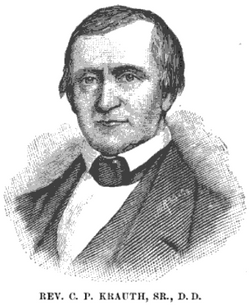
When Charles P. Krauth yielded the presidency of Pennsylvania College to Reverend Henry Louis Baugher in 1850, he had been at the helm for sixteen years. He was 53 years old, and after a lifetime of ecclesiastical service, you might assume that he was ready to retire. But Dr. Krauth did not retire—he stayed on…
-
Reverend Henry Louis Baugher: The Force Behind Christ’s Church (Lutheran)

That teacher that won’t cancel classes during a blizzard or a major national event, that ensures you always get the homework assignment . . . that was Henry Louis Baugher. If Christ’s Church (Lutheran) was the physical object that brought Gettysburg College, the Lutheran Theological Seminary, and religious worship together, the force behind them was…
-
The Role of Christ’s Church Before, During, and After the Battle of Gettysburg

When considering its history with the Battle of Gettysburg, Christ’s Church (now known as Christ Evangelical Lutheran Church) is best remembered for the killing of clergyman Horatio Stockton Howell (more on that below) and the sheltering of Ole Liz Butler, a black washerwoman who escaped Confederate cavalry and hid until the battle concluded. The Church…
-
Life and Death on the Farm of John and Elizabeth Wible

The lives of Reverend John Wible and his wife, Elizabeth Wible (Stallsmith), appear to have passed without generating a lot of notice. The reverend worked at the Christ’s Lutheran Church (which played a prominent role in the battle). Elizabeth was from a long-running family in the area. They had no children. They turn up in…
-
Joseph Sherfy: Creator and Guardian of Gettysburg’s Peach Orchard

Today, the peach orchard of Joseph Sherfy has become The Peach Orchard even to the casual student of the town and battle. Books and books have been written on its importance, the violence that took place within it, and its overall strategic impact on the three-day battle. Most don’t know, though, that the peach orchard…
-
Life of Reverend John Herbst: Faith and Farming in 19th Century Pennsylvania
Reverend John Herbst was born in 1793 in York, Pennsylvania, a son of John Heinrich Herbst (who went by Henry) and his wife Catherine. The Herbsts were part of the early Pennsylvania German community that helped build Adams County. Raised with strong traditions of faith, farming, and hard work, John was one of ten children…
-
Reverend Michael Bushman: A Gettysburg Legacy
Perhaps the most prominent manmade structure associated with July 2, 1863, is the home of Reverend Michael Bushman. The brother of Emanuel Paul Bushman and the uncle of Sadie Bushman, Michael Bushman (1812–1893) was a prominent figure in Gettysburg, Pennsylvania, known for his leadership in the German Baptist Brethren Church and his ownership of a…
-
Julia Eyster Jacobs: A Legacy of Faith and Family
These days, no ink is spilled on Julia Eyster Jacobs, wife of Dr. Michael Jacobs. Likewise, little has been said or written in decades about their daughter, Mary Julia. But these were powerful women, steeped in deep faith who made tremendous sacrifices for their beliefs. The first time we find mention of Julia Eyster is…
-
Memories of Gettysburg: Reverend Henry Eyster Jacobs and the Changing Landscape
Reverend Henry Eyster Jacobs took after his father, Dr. Michael Jacobs. He followed him into the Lutheran clergy; he was a teacher, a writer, and a keen observer of the era he lived in. The oldest of four, he was born in 1844 when his parents had been married for 11 years; his father was…
-
Dr. Michael Jacobs: Far More than Gettysburg’s Unsung Weatherman
At the conclusion of July 3, 1863, Dr. Michael Jacobs noted dryly in his weather record, “The thunder seemed tame, after the artillery firing of the afternoon.” Of course, the artillery barrage of that afternoon was likely the largest that had occurred in history to that point. Similarly, the thunderstorm was a prelude to a…