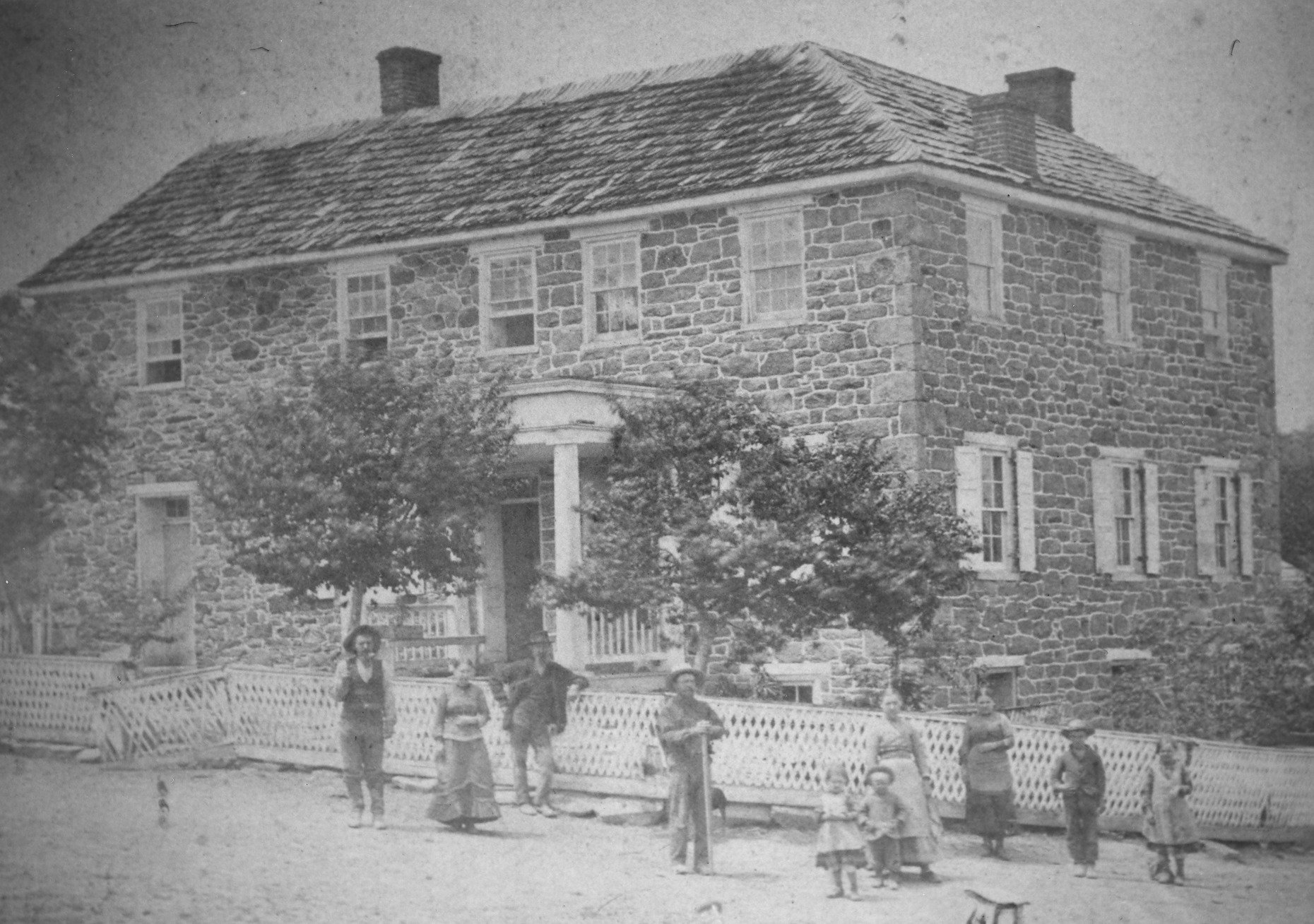
Today, the story of Tillie Pierce and her family has been subsumed by the story of the battle, Tillie’s recollections of it, and the landmark house that is now a bed and breakfast. Like the Jennie Wade House, the Hotel Gettysburg, the Farnsworth House Inn, and the Rupp House and Tannery, the site has also acquired its own ghost stories and legends. But the Pierces were one of Gettysburg’s most prominent families with prosperous businesses and substantial land holdings. They were involved deeply in civic affairs, and part of what gives Tillie Pierce’s account authority is the prominence the family had in town.

The Pierce Family in Gettysburg
Built in 1829 at 301–303 Baltimore Street in Gettysburg, the red-brick home now known as the Tillie Pierce House Inn was originally the family residence of butcher James Pierce (1806–1896) and his wife Margaret A. (McCurdy) Pierce (1810–1881). Matilda Jane “Tillie” Pierce (1848–1914) was born and raised here as the youngest of their four children. In 1860 the federal census listed the Pierces (James and Margaret) living above the butcher shop with children James Shaw (b.1836), William H. (b.1841), Maggie (b.1845), and 12-year-old Tillie. Tillie’s father was originally from Maryland and her mother from Clearfield County, Pennsylvania. The Pierce household was prosperous – by 1860 James’s real estate and personal property were valued at $6,500, making him one of Gettysburg’s wealthier citizens.
As a butcher, James Pierce was in business with Nicholas Codori and his brother George. (Both Codoris lived in town near James where they operated the butchery, though Nicholas also owned the farm that is now famous for its role in the battle.)

This was not James’s only business. He owned real estate, some of which he rented as public baths.

He also bought substantial land in the area.

And he built a separate red-brick home on nearby Breckenridge Street.

Margaret Pierce would also figure prominently in town, particularly in post-battle affairs as we will see later.
The Battle of Gettysburg and Tillie’s Memoir
When the Civil War came to Gettysburg in July 1863, the teenage Tillie Pierce witnessed its horrors firsthand. As Confederate forces advanced, her family sent Tillie to nearby Jacob Weikert’s farm (at the foot of Little Round Top) for safety. Instead, she arrived late on July 1, just in time for the fierce fighting on July 2 that enveloped the fields and round tops south of town. During the battle Tillie (though only 15) bravely cared for wounded soldiers: fetching water, bringing food, and helping nurses and a chaplain with first aid. Those experiences deeply affected her, and she later recorded them in At Gettysburg, or What a Girl Saw and Heard of the Battle (published 1889) – now recognized as one of the most vivid civilian accounts of the battle.
After the Union victory, Tillie returned home to find Baltimore Street scarred by war. The Pierce house itself had been pressed into service as a field hospital – local accounts note that by July 7 the family’s parlor and barn were overflowing with wounded soldiers. In her memoir she even described bullet holes in the house’s upper balcony and riddled walls from the fighting. For example, later photographs (and surviving walls) show about 17 bullet marks on the south wall of the house – grim evidence of the nearby combat. Gettysburg’s dead and dying lay in the street and yards around the house, and residents remember the air filled with moans and groans. (It was such vivid detail that one Gettysburg historian described Tillie’s narrative as a “truly pitiable gathering” of the wounded.)
Aftermath: Family and Genealogy
After the wounded were cleared out, the family remained active in alleviating suffering. You may recall the story of the Gettysburg Homestead Orphanage, the creation of which was triggered by the tragic death of Union soldier Amos Humiston. Margaret Pierce was actively involved in the creation and early management of the orphanage.

When the war ended, the Pierce family was reunited in Gettysburg – James Shaw and William H. returned from service – but the postwar years held more heartache. In 1867, just two years later, their older sister Margaret “Maggie” Pierce died at age 22. By 1870, federal census records show 21-year-old Tillie as the only Pierce child still living at home with her parents. The family’s butcher shop and home continued under James Pierce’s ownership for a time.
In 1871 Tillie married Horace P. Alleman (1847–1908), a Harrisburg attorney and Civil War veteran, at Gettysburg’s Christ Lutheran Church. The young couple moved to Selinsgrove in Snyder County, PA, where they settled into the former mansion of Governor Simon Snyder. There they had three children: Henry Pierce Alleman (1872–1949), Anna Margaret Alleman (1878–1926), and Mary Alleman (born 1882). (Anna later married Richard H. Colburn, who was about 40 years her senior.)
Despite leaving Gettysburg, Tillie did not forget her childhood home. In the late 1800s she was granted the deed to the family house at Baltimore and Breckenridge Streets. (According to local historian Mark Walters, the property had passed from William Breckenridge to William McCurdy, and then to James Pierce, and finally to Tillie Alleman.) By the time of her death (Tillie died of cancer in 1914 at age 66) she still owned the old house, although she was living in Philadelphia at that time. Tillie was buried in Selinsgrove Lutheran Cemetery. Her husband Horace passed away in 1908, so none of the Alleman children inherited the Gettysburg house, and it eventually left the Pierce family’s direct stewardship.
Through the 20th century the building remained a private home. By the early 2000s it was purchased and carefully restored to its mid-19th-century appearance. In 2005–2007 historic preservationists refurbished the exterior and interior, earning a local preservation award. After restoration, the building was reopened as the Tillie Pierce House Inn, a bed-and-breakfast that honors its Civil War history. The innkeepers maintain period decor and display copies of Tillie’s book, inviting guests to “step back in time” just as Tillie did in her youth. Even the inn’s website calls the house a “living museum” with Victorian charm. Today the Tillie Pierce House Inn advertises Wi-Fi and modern comforts alongside its antebellum heritage, blending history with hospitality.
Ghost Stories and Paranormal Tourism
Over the years the Tillie Pierce House has also earned a reputation as one of Gettysburg’s most haunted locations. The inn is featured on many ghost tours and paranormal blogs; one ghost-tour website notes that “even though its food and lodging are excellent, it’s achieved notability for another reason entirely: its ghosts.” Visitors and ghost-hunters report numerous unexplained phenomena. For example:
- Blue Room & Civil War apparitions: The second-floor “Blue Room” is famously believed to be Tillie’s personal haunt. Guests often hear phantom footsteps in this room and along the hallway, as if wounded soldiers (whom Tillie tended here) are still marching through. Witnesses have seen a shadowy figure – described as a man in a long coat – gliding on the staircase. One guest even saw an apparition sitting on the edge of a bed. The prevalence of such visions has led investigators to connect them with Tillie’s wartime service; paranormal tours sometimes attribute these to Union soldiers she once cared for.
- Children’s laughter and play: Another common report is the sound of children playing or whispering, even when no children are present. Late at night guests have heard the scuff of small footsteps or the clatter of toys in empty hallways. Some believe these are residual echoes of town children or drummer boys who suffered in nearby fighting. (One paranormal blog wryly notes that the innkeepers leave a bowl of toy balls in the upstairs hallway “in case you didn’t bring any ghost-hunting equipment.”)
- Weeping woman: In several ghost tour accounts, travelers report hearing a woman crying from an upstairs room. One guest described a soft sobbing that seemed to come from a corner of the room late at night. Some theories suggest this is Tillie or a grieving mother reliving the loss of loved ones; ghost-city tours link it to the emotional trauma of the house’s past.
- Cold spots, touches, and scents: Unexplained cold spots and physical sensations are also frequently mentioned. Guests have felt sudden chills, heard unseen tugging on bedcovers, or found furniture oddly shifted in the morning. In one account a woman awoke to find a chair moved across the room during the night. Intriguingly, some have reported smelling lilacs – Tillie’s favorite flower – in the hallway even when none are present.
Because of these stories, the Tillie Pierce House is a frequent stop on Gettysburg’s paranormal tours. Both the Gettysburg Ghost Tours and Ghost City Tours include the inn in their haunted itineraries. Even national TV and radio programs have featured it among Gettysburg’s spectral landmarks. The inn’s own website acknowledges the lore with a tagline that guests might “experience Tillie’s remarkable story” firsthand. In sum, the house that sheltered a Civil War heroine now draws both history buffs and ghost hunters alike. As one blogger put it, the Tillie Pierce House “isn’t just another historic building – it’s a living memorial, a place where the echoes of war still reverberate.”
Leave a Reply