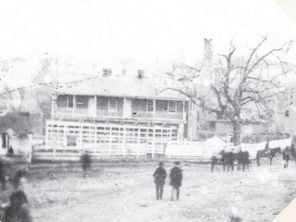
The Rupp House is close to the Jennie Wade House and the Farnsworth House Inn, and it’s just south of the Hotel Gettysburg. It stands at 451 Baltimore Street in Gettysburg, PA, and today houses the Children of Gettysburg 1863® museum (a Gettysburg Foundation interactive history center). In the 1860s this Gothic-Revival home belonged to John Rupp (pronounced “Roop”) and his wife Caroline, who raised six young children there. John Rupp was a wealthy local tanner – the house’s very design reflected “the success of Rupp’s Valuable Steam Tannery,” according to historic markers. In fact, a historic sign notes that the existing building was “constructed in 1868 for John Rupp” after the original Civil-War-era house was heavily damaged. At the time of the Battle of Gettysburg (July 1–3, 1863), John and Caroline Rupp were living at this home with their six children. John’s father, Henry Rupp, also lived a few blocks away.
The Rupp tannery would have stood out to everyone in town. A tanner in the 19th century turned raw animal hides—mostly cow, horse, or deer—into leather through a labor-intensive and often unpleasant process.
Raw Material Collection
Hides were sourced from local butchers or farms. The tanner would often trade or buy them directly.
Soaking & Dehairing
The hides were soaked in water to soften them, then treated with lime to loosen the hair, which was scraped off with special knives.
Fleshing
Leftover fat, flesh, and tissue were scraped away. This was hard manual labor and had to be done precisely to avoid ruining the hide.
Tanning with Bark
The hides were soaked in vats filled with tannin-rich liquids, often made from oak or hemlock bark, which preserved and toughened the leather. This process could take weeks or even months.
Drying & Finishing
After tanning, hides were dried, trimmed, and sometimes dyed or oiled. The finished leather was then sold to shoemakers, saddle makers, bookbinders, or harness shops.
Tanning was notoriously smelly—the combination of rotting flesh, lime, and bark vats gave off a stench that made tanneries unpopular neighbors. Waste from tanneries could pollute local streams, which was a common concern in towns like Gettysburg. Despite the unpleasantness, tanning was a skilled and profitable trade. Leather was essential for everyday life: shoes, belts, saddles, gloves, even military gear like cartridge boxes and harnesses. John Rupp operated what was called a “valuable steam tannery,” meaning he likely had mechanized some processes using steam power—advanced for the time. His tannery was a local industrial asset and a source of income that helped him build one of the nicer homes on Baltimore Street.
Civil War Era – The Rupps in Gettysburg

When General Lee’s Confederate army entered Gettysburg on July 1, 1863, the Rupp family found themselves caught between the opposing forces. Contemporary accounts tell how the Rupps took refuge in basements. On July 1, John Rupp moved Caroline and the children across the street into their neighbor Solomon Welty’s stone cellar for safety. (The Welty House was only a few doors away and sheltered both families.) For most of July 2 the Rupps then hid in the Rupps’ own basement at their Baltimore Street home. That night John’s father Henry managed to sneak into town and escort Caroline and the children (by lantern-light) to Henry’s home eight blocks away, out of harm’s way. John Rupp himself – a member of the local militia – stayed behind to protect the house and his tannery business.
A number of sources record that the Rupp House became a little battlefield. In one dramatic description, “one night” during the fighting Union forces advanced from one direction and Confederates from another, so that “Union men [were] shooting at Confederates from the porch, and the Confederates returning fire from the rear of the house. All the while, John Rupp hid for his life.” John later wrote in a letter that “Our men occupied my porch, and the rebel men the rear of the house, and I in the cellar… our house is pretty well riddled.” Remarkably, though Union and Confederate skirmishers crossed shots right at the house, none of the Rupp family were hurt – only the home and nearby structures were struck. (In fact, on July 3 Union artillery aimed to destroy the Welty House because sharpshooters were hiding there, but were ordered to spare the brick building to avoid civilian casualties.)
During this period, the Welty House across the street also saw intense fighting (it sheltered both the Welty and Rupp families at times) and retains Civil War damage. A spring still runs in Welty’s basement, which John Rupp explicitly mentioned had kept his family supplied with water during the hours they hid there. Another nearby landmark is the Jennie Wade House, where the only civilian casualty of the battle was killed by a sharpshooter’s bullet – one shot believed by many to have come from the Welty position.
After the Battle – Rebuilding and Change
After Gettysburg, the Rupp family home was left heavily damaged. John Rupp rebuilt on the property in 1868, erecting the brick Gothic-Revival cottage that stands today. This new Rupp House closely matches period photographs and describes the family’s prosperity: it is said to have been “one of the finest” homes on Baltimore Street, reflecting the success of Rupp’s tannery business. John and Caroline Rupp continued to live in this rebuilt house after the war (Caroline survived John, who died in 1871). The Rupp children grew up here during Reconstruction. Eventually the house passed through other owners, but it remained a private residence for over a century. In the 1960s it was acquired by the Gettysburg Foundation to serve as a history center and museum.
Rupp House Today – History Center and Museum

Restored and opened to the public in the 21st century, the Rupp House History Center operates as an interactive museum for families. Visitors walk through period rooms and hands-on exhibits that tell the stories of Gettysburg’s young people – including the Rupp children – “during and after the 1863 battle.” The foundation’s website notes that in 1863 “John and Caroline Rupp lived in this house with their six children,” making it a true family home. Today the house is set up with costumed interpreters, living-history events, and educational programs (for example, children can carry the heavy pack of a Union soldier or deliver a mock Gettysburg Address). Admission is free for youth and very affordable, reflecting its mission as a family-friendly site.

Over time the Rupp House has remained associated with the theme of children and families. The current Children of Gettysburg 1863® exhibit is explicitly based on the fact that John Rupp had six kids aged infant to pre-teen at Gettysburg. (This is why it is billed as “for the entire family” – a fitting legacy of the Rupp household.) The house’s Civil War heritage is preserved: old bullet holes are still visible on the foundation of the cellar, and period artifacts from 1863 are on display. The property’s address (451 Baltimore Street) and its proximity to Gettysburg National Cemetery make it an easy stop for history tourists.
Ghost Stories and Hauntings
Over the past few decades the Rupp House has also become a popular “haunted” tour stop in Gettysburg. Ghost walks and paranormal guides note that although the Rupp family survived unharmed, many soldiers died nearby, leaving a lingering presence. In fact, US Ghost Adventures calls the Rupp House “one of the most haunted sites in this city of ghosts… now ironically operat[ing] as a children’s museum.” Tales of war-time trauma and loss contribute to the lore.
Visitors and staff have reported eerie sounds and sights. For example:
- Guests at the bed-and-breakfast next door say they hear phantom artillery fire echoes and distant knocking or wailing coming from the Rupp House property.
- Some claim to glimpse shadowy soldierly faces peering out of the darkened windows.
- Museum volunteers often hear unexplained footsteps or creaking boards on empty floors during the day.
- These accounts echo the house’s violent history: one ghost tour site even describes John Rupp’s wartime experience as a “house divided,” with him hiding in the cellar while battle raged overhead. (That narrative blurs into legend, but it resonates with modern witnesses.)
To some, these phenomena have spiritual meaning; to others they are atmospheric coincidences. In any case, the stories have helped draw tourists: the Rupp House regularly appears on Gettysburg ghost tours and in books about paranormal Civil War sites. Paranormal databases list “phantom artillery,” spectral soldiers, and midday footsteps among the Rupp House’s reported phenomena. (So far, we find no reports of ghost cows or other animals whose hides were processed at the site.) Whether one believes in ghosts or not, the combination of authentic history and spooky tales makes the Rupp House a memorable stop on any Civil War excursion.
Related Rupp Houses and Sites
It’s worth noting that the “Rupp House” name appears elsewhere in Civil War history. For instance, in Mechanicsburg, PA (Cumberland County) stands the Jonas Rupp House, a stone mansion built in 1787 by Jonas Rupp (a German immigrant and Revolutionary War veteran). Jonas’s grandson – another John Rupp – also lived there in 1863. During the Confederate advance into central Pennsylvania, that Mechanicsburg Rupp house was briefly used as a Confederate headquarters by General Albert Jenkins. The family fled to Lancaster, just as the Gettysburg Rupps escaped to the Welty cellar. (Like its Gettysburg namesake, the Jonas Rupp House has modern ghost stories: its current owners report hearing unexplained noises and smelling pipe smoke, claiming “Jonas is probably here” among the spirits.) These two Rupp houses share a surname and Civil War pedigree, but are otherwise independent.
Back in Gettysburg, the nearby Welty House deserves mention as well. Solomon Welty’s home – where the Rupps sheltered on July 1 – still stands on Baltimore Street. It, too, is preserved and often pointed out on tours (and is itself on some ghost tours). In sum, the Rupp House on Baltimore Street is a tangible link to Gettysburg’s civilian side of the battle: its walls witnessed the terror of July 1863, its reconstruction embodies post-war recovery, and today its halls blend family history with friendly scares.

Leave a Reply