Years ago, we took the kids to Gettysburg for a couple of days and signed up for a ghost tour on our first evening. Of course, we visited the Gettysburg Homestead Orphanage site and heard all the tales. We also paused on Baltimore Street while our guide told us that people often smelled pipe and cigar smoke when no one was smoking. Someone in our party whispered, “I can smell tobacco right now,” and our friend turned to me and said, “We’re standing in front of a tobacco shop.”
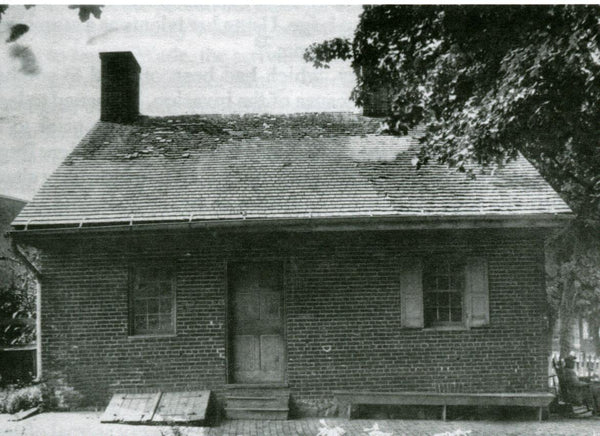
We stopped at the house presently labeled the Jennie Wade House, though it was really the home of Jennie’s sister Georgia, Georgia’s husband, and their new baby. Our guide told us that the house was known to have several spirits, among its most prominent being that of Captain James Wade, Jennie’s father. Captain Wade was not at home at the time of the battle, but was housed at the Alms House owing to his criminal history and mental health problems. The story goes that he missed Jennie’s death and burial, feels guilt over it, and wanders the Jennie Wade House, periodically looking out on all of us. The guide advised us to take pictures of the outside of the house and check later to see if we had perhaps captured Captain Wade looking out the windows at us. Naturally, we all raised our cellphones and obliged.
Later that evening when we were sitting around a restaurant table, our friend suddenly exclaimed, “Oh my gosh! There he is!” She passed her phone around and showed us the photo that you can see below.

We pulled up the old image of Captain Wade and half-convinced ourselves that it was the same man in the window.

But Captain Wade isn’t the only alleged ghost in the house, and the history of the house and its stories is a tale of its own.
Background and Jennie Wade’s Move to Baltimore Street
Mary Virginia “Jennie” Wade was the second of six children born to James and Mary Wade. Many people will often assume that “Jennie” is a later misspelling of Ginny, short for Virginia. Jennie’s mother was Mary Ann Wade, so her daughter went by the nickname of her middle name. That assumption is incorrect. Even in her day, Jack Skelly wrote to both his mother and Jennie herself, calling her “Jennie.”
Jennie’s young life mostly took place in about a two-block radius. (Check out the Interactive Map. Blow it up some and look at the sites on Baltimore Street and Breckenridge Street.) She was born at 246 Baltimore Street where her father operated his tailoring business. At the time of the battle, she lived at 51 Breckenridge Street, northwest of her sister’s home.
When the Confederate army approached Gettysburg in late June 1863, Jennie’s father was at the Alms House and her friend and possible paramour, Corporal Jack Skelly of the 87th Pennsylvania, had been mortally wounded at the Battle of Winchester.
Jennie and her mother lived on Breckenridge Street, but during the battle they moved to the duplex at 548 Baltimore Street—home of her married sister Georgia Wade McClellan—to help Georgia recover from childbirth and to escape the heavy shelling. Georgia’s husband John Louis McClellan, a wheelwright, was away on service with the Union army. The duplex’s north half belonged to the McClellan family, while the south half belonged to Isaac Newton McClain’s family. (The north side faces the center of town; the south side faces the upward slope of Cemetery Hill.)
Occupants on July 3, 1863
According to J. W. Johnston’s The True Story of “Jennie” Wade (1917), the house’s north half contained:
- Mary Wade (Jennie’s mother),
- Jennie,
- Georgia McClellan (Jennie’s sister),
- Georgia’s three‑day‑old son,
- Jennie’s younger brothers John and Sam, and
- Two Union soldiers who mysteriously appeared upstairs and helped defend the house.
Georgia’s half of the duplex was between the Union line on Cemetery Hill and the Confederate positions along East Cemetery Hill, making it an ideal firing position. Throughout 3 July 1863 more than 150 bullets and shells struck the house, and later investigations showed that Union sharpshooters fired through the attic windows while Confederates fired from the opposite hill.
The Morning of the Fatal Shot
Jennie rose before dawn on 3 July, gathering firewood to bake bread. She mixed dough and promised a hungry soldier biscuits after breakfast. About 8:30 a.m. a Minié ball fired by a Confederate soldier pierced the front door of the McClellan side, passed through the parlor door, and struck Jennie just below the left shoulder blade. She died instantly without making a sound, falling to the floor as her mother watched. Jennie’s selflessness was evident earlier when she told her family: “If there is anyone in this house that is to be killed today, I hope it is me, as Georgia has that little baby.”
Handling of the Body
Union soldiers occupying the house quickly took charge. Realizing it was too dangerous to remove her body above ground, they cut a hole through the partition wall and carried Jennie, wrapped in a quilt, into the south‑side cellar, placing her on a bench while the family huddled around her. The cellar served as the family’s shelter; the body remained there from 8:30 a.m. until around 1 a.m. on 4 July when the firing subsided. Afterward Mary Wade returned to the kitchen and used the dough her daughter had mixed to bake fifteen loaves of bread, which she gave to Union soldiers.
Later that week soldiers buried Jennie in the garden beside the house using a coffin meant for Confederate General William Barksdale. In January 1864 she was reinterred at the nearby German Reformed Church cemetery, and in November 1865 her body was moved to Evergreen Cemetery, where she rests near the grave of her friend Jack Skelly. Her monument carries the only perpetual American flag permitted over a female’s grave other than Betsy Ross’s.
From Family Home to Museum
After the battle the McClellan family sold their half of the duplex in 1866 to James A. Kitzmiller. Kitzmiller’s daughters, Harold Mumper and Robert C. Miller’s wife, inherited the property. Robert C. Miller, a local printer and former postmaster, recognized the public’s fascination with Gettysburg and began operating the home as a museum in 1901. A 1909 souvenir booklet described Miller as “custodian of the Jennie Wade House,” noting that the house remained unchanged and was attracting thousands of visitors to see its bullet‑scarred doors and Civil‑War relics.
Miller’s museum displayed the doors pierced by the fatal Minié ball, furniture, and relics found on the battlefield. He preserved the hole cut in the wall where Jennie’s body had been carried and told visitors the story of her death.
Later Owners and Commercialization
After Robert C. Miller’s death in 1930, management of the museum passed to his son‑in‑law William G. Weaver, a former Gettysburg mayor. During the 1950s the Kitzmiller heirs sold the property and its collection to L. E. Smith, a local businessman. Smith partnered with actor Cliff Arquette (famed for his “Charlie Weaver” character) to form Gettysburg Tours, Inc. In March 1959 Arquette opened “Cliff Arquette’s Soldiers Museum,” later renamed Charlie Weaver’s American Museum of the Civil War; many of the artifacts were moved to the Soldiers National Museum while the Jennie Wade House continued to be promoted as a stand‑alone attraction. Today the house is operated by Gettysburg Heritage Enterprises, the same company that manages the Ghostly Images and Haunted Orphanage tours.
Ghost Stories and Legends
The ring‑finger legend—that an unmarried woman who places her ring finger in the bullet hole of the front door will soon become engaged—appears in souvenir literature as early as the early twentieth century. A framed testimonial displayed in the house contains letters from young women who tried the ritual and later became engaged, suggesting the story circulated among tourists by the 1900s. The legend hinges on Jennie’s supposed unfulfilled engagement to Jack Skelly, who died of wounds shortly after the Battle of Winchester, to encourage visitors to participate in a romantic ritual.
Other stories report that visitors smell freshly baked bread near the kitchen or hear faint moaning in the cellar; ghost‑tour companies claim to have recorded electronic voice phenomena. An early 20th‑century newspaper article noted that Jack Skelly’s sister believed Jack died calling her name, a story later recast to suggest that Jennie’s spirit waits for him in the house. Contemporary paranormal websites repeat claims that the spirits of Confederate and Union soldiers haunt the attic and cellar. These tales have no foundation in contemporary 1863 sources; rather, they reflect modern tourism’s fascination with hauntings and the commercial appeal of Gettysburg ghost tours. Historian Keith Harris argues that the ring‑finger myth and other ghostly narratives stem from an “interplay of history and consumer culture” that sometimes distorts the reality of a young woman caught in crossfire.
Evaluation of the Stories
- Primary sources: Contemporary accounts such as Johnston’s 1917 book and the 1909 souvenir booklet speak of Jennie’s death and the preservation of the house but contain no references to supernatural events, suggesting that ghost stories emerged later. The earliest widely documented legend is the ring‑finger engagement ritual.
- Modern ghost tours: The commercialization of the house in the late 20th century coincided with the rise of ghost tours. Companies like Ghostly Images use theatrical storytelling, electronic “evidence,” and the ring‑finger myth to attract visitors. While these stories have become part of the house’s popular lore, they are not supported by historical documents.
Significance and Legacy
The Jennie Wade House stands today as a museum that interprets the experience of Gettysburg’s civilians. Visitors walk through the parlor where the fatal bullet passed, view the preserved doors and bullet hole, and descend to the cellar where Jennie’s body lay. Interpretive displays discuss the Wade and McClellan families, the separation of the duplex, and the heavy fighting on Cemetery Hill. The site thus provides a tangible reminder of the battle’s impact on non‑combatants and the precariousness of everyday life during war.
Beyond its educational value, the house illustrates broader themes in heritage tourism: the transformation of private homes into museums; the role of entrepreneurs like Robert C. Miller and Cliff Arquette in shaping public memory; and the persistence of folklore in marketing. The ghost stories, while entertaining, reveal how commerce can overlay myth upon history. Yet, as visitors place their fingers in the bullet hole or contemplate Jennie’s grave in Evergreen Cemetery, they connect with the tragedy of a nineteen‑year‑old woman whose household tasks unexpectedly intersected with one of America’s pivotal battles.
Leave a Reply to The Dobbin House, the Underground Railroad, and a History of Hauntings – The Gettysburg Network of 1863Cancel reply