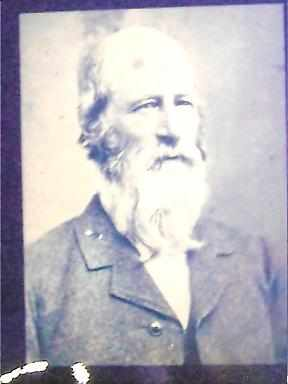
The Legend of John Forney, his wanderings, his farm, and the role of his property in the Battle of Gettysburg was forged during his own lifetime. Forney’s property today is home to the Eternal Light Peace Memorial, and tales of the disaster of Iverson’s Brigade on his land are told on most tours. Further, ghost stories have cropped up in the last couple of decades that allegedly date back to the battle and the creation of Iverson’s Pits.
But it’s possible, and hear me out on this, that parts of this legend are just a tad bit embellished. For example, the following article from one of John Forney’s cousins is presently on his Find-a-Grave Memorial Page.
“John Swope Forney was born in Gettysburg, Pa., February 17, 1830. He married, February 21, 1861, Mary Shriver. He received his education at Oak Ridge Academy and Pennsylvania College. In 1849 he joined a company for California. They spent the winter of ’49 and ’50 at Salt Lake with the Mormons. Continuing their journey in the Spring they crossed the Sierra Madre mountains with no guidance but blazed trees at long intervals. He began prospecting in 1851, but not being successful he left California for Oregon, where he remained a year. Returning to California he spent some time vainly ‘wooing fickle fortune.’ He returned to his home in Gettysburg 1859. The following year he bought the farm on which he now resides, 1 1/4 miles north of Gettysburg, on Seminary Ridge. This farm is part of the historic battlefield of Gettysburg. About the 28th of June, 1863, Jenkins’ Cavalry, an advance scouting party of the Confederate Army occupied the place, and a few days later, during the battle, the house was made the headquarters of General Ewell. Just above the house was placed the largest gun of the Confederate army, which discharged its shell over Gettysburg to Round Top, a distance of four miles. Everything about the place was completely destroyed by the battle except the house and barn, and they were all riddled by shot and shell. The house now bears but few scars from that memorable event, the skill of the artisan having erased them, while the well-kept terraces of the lawn gives no evidence of the terrible combat that raged on its surface, or the brave men who were embraced in its bosom, after giving up their lives for their country. The farm is now marked by some of the finest monuments on the battlefield and traversed by several avenues. Mrs. Forney relates some very thrilling experiences incident to the battle. One was her escape from her home with an infant in her arms at midnight, through a country filled with soldiers, to her father’s house, a mile away. Another was her return to her home during the battle and her efforts to save from destruction some of her household treasures. In this she was partly successful, as the Confederate soldiers in possession treated her with the courtesy due a lady.”
So John Forney allegedly lived nearly coast-to-coast, settled back into Gettysburg, saw his land become a major focal point of the country’s costliest battle, had one of the battle’s great generals make his headquarters there, saw a general make a fatal error that annihilated his brigade, and saw a gigantic cannon launch a shell four miles to the Round Tops. Mix in his wife running for her life with an infant, and you have an amazing story. All true, though? Wellll . . .
John Forney at Gettysburg
John Swope Forney (b. Feb. 17, 1830 – d. 1906) was a Gettysburg-born farmer whose Oak Ridge acreage would become a bloody first-day battlefield and later part of the Gettysburg National Military Park. Forney’s property – about 30+ acres of active farmland with orchards and fields north of town near the Mummasburg Road (modern Buford Avenue) – was owned by the Forney family for generations. (Genealogical records show he was born in Gettysburg to Samuel and Eliza Forney and married Mary Elizabeth Shriver in February 1861.) John and Mary Forney settled on this land before the war, operating a mixed farm.
On July 1, 1863, Forney’s farm lay across the first-day battle lines. Confederate General Alfred Iverson’s North Carolina brigade was ordered to attack the Union I Corps positions on Oak Ridge. By mid-afternoon Iverson’s troops advanced across John Forney’s fields, seeking to outflank the Union line. Advancing into a blaze of rifle fire from a stone wall on Oak Ridge, the North Carolinians were caught in murderous enfilade fire. Within moments, hundreds of Confederate soldiers had fallen across the Forney fields. The ambush sent nearly 900 of Iverson’s men to the ground in a matter of minutes. John Forney’s farm buildings and orchard were struck by Union artillery fire, and his corn, wheat and hay crops (on the order of 30–32 acres of wheat, plus oats, timothy and corn) were damaged or burned. Union artillery also damaged the Forney house. In the chaos of battle, wounded and dying Confederate men filled the fields.
In the hours after the fight, the battlefield became a mass grave. Soldiers from both sides began burying the dead where they fell. On Forney’s land, the graves were dug in long trenches on Oak Ridge. Eye-witnesses noted that “the fallen were interred in rows of hastily dug grave trenches—virtually in the same spots where they fell.” (One of the better known deaths was that of Oliver Evans Mercer, a former North Carolina planter turned Confederate officer.) Over the next weeks the earth settled into sunken furrows in Forney’s fields. Locals came to call the site “Iverson’s Pits” – a grim reference to the trenches – and to tell stories about it. One long-lasting tale was that at harvest time “the wheat always grew tallest” over these graves. (In fact, nearly 900 Confederate bodies lay in those trenches on the Forney farm after July 1.)
Forney himself was directly involved in the aftermath. His farm buildings were used as an improvised hospital for wounded soldiers immediately after the battle. Eventually the bodies buried in Iverson’s trenches were exhumed and reinterred in Confederate cemeteries during the 1870s; by then the Forney fields were cleared of the dead.
Despite the horror of the battle, the Forneys returned to farming after the war. Yet for decades the farm carried an air of haunted legend. Local lore told of ghostly Confederate figures seen on the fields at dusk. Forney’s tenants complained of strange lights and eerie sounds around the old pits, and folk tales about restless battlefield spirits became common. Tour guides today still note Iverson’s Pits as one of Gettysburg’s most notorious haunted spots. (One popular saying is that Forney’s farmhands refused to remain anywhere near the vicinity after sunset out of fear.)
The Forney Farm After the War
During the 1920s, much of the Forney land changed once again. In 1927 John Forney’s son (John Jr.) leased 66 acres of the family farm to create a small Gettysburg Airport for sightseeing flights. The grass airstrip and a single hangar occupied Forney fields that had once been trampled by bayonets. A contemporary brochure advertised “fly-over battlefield” tours from the new airport. Today no trace of the airfield remains except a concrete slab. The tiny foundation of the old hangar is all that survives – a lonely marker of this brief chapter in the farm’s history.
In the 1930s the Commonwealth of Pennsylvania (working with the new National Park Service) acquired the Forney land to create park monuments. In 1937 the state purchased 33 acres of Oak Ridge – including the Forney house and outbuildings – for the Eternal Light Peace Memorial atop Oak Hill. Park planners decided the old Forney farmhouse and barn, then in disrepair, would be torn down to clear the viewshed around the new memorial. By 1940 the farm buildings were gone, and only the orchard remained. The orchard has since been replanted and preserved, and the only reminder of the Forneys’ home today is the flat ground where it once stood.

Today the Eternal Light Peace Memorial overlooks the land that was once Forney’s fields. Gettysburg visitors often walk the memorial’s plaza unaware that the peaceful farm on Oak Ridge was once the site of a terrible slaughter. Although Forney’s house and barn no longer stand, the restored apple orchard still grows where it did in 1863. Oak Ridge bears subtle hints of its layered history: the concrete foundation of the old airport and a few stone remnants in the orchard are all that remain of the Forney farmstead. John S. Forney himself lived out his life in Gettysburg, remaining a farmer and local leader until his death in 1906. His family continued farming into the 20th century, but by 1940 all vestiges of the Forney home had been removed for the park. The story of the Forney farm – from quiet farm to battlefield, from ghost stories to modern memorial – survives in local records and memories, and in the very ground of Gettysburg’s Oak Ridge.
The Truth of the Family Legends
So those are the documentary facts pertaining to the battle. What about other tales that the family recorded? Here’s an evaluation of each of the claims on Find-a-Grave after a look at period and family history sources.
- Gold Rush travels (Claim 1): Contemporary family histories confirm that John S. Forney did head West around 1849. The 1896 History of the Swope Family explicitly states he joined a wagon train to California in 1849, wintered “’49 and ’50 at Salt Lake with the Mormons,” then spent 1851–59 prospecting in Oregon and California before returning to Gettysburg in 1859. This matches county biographies of Gettysburg (c.1900) noting his one‐winter stop at Salt Lake City and a ten-year stay in California. We found no contradictory records, so the Gold Rush/Mormon narrative appears historically plausible.
- House as Gen. Ewell’s headquarters (Claim 2): This is almost certainly false. Swope’s book claims “during the battle the house was made the headquarters of General Ewell,” but no official or modern source supports that. Gettysburg scholarship and markers place Ewell’s July 1 headquarters much farther north/west (e.g. the Lott Farm on Hanover Road and Blocher House near Two Taverns Road). An NPS symposium report explicitly lists sites of Ewell’s headquarters (Blocher House, Alms House, Lott Farm, etc.) and does not mention Forney’s farm. In short, battlefield studies show no Confederate HQ at the Forney house on Seminary Ridge, so this claim is not confirmed.
- “Largest gun” firing to Round Top (Claim 3): We found no evidence any “largest” Confederate cannon was placed on Forney’s farm or fired 4 miles. The family history text makes that dramatic claim, but detailed artillery records and battle accounts list only ordinary batteries (Napoleons, 24‑pounder howitzers, 3″ rifled guns, etc.) on Seminary Ridge – none with 4‑mile range. (Most of these had max ranges of 3200 meters, and really, most firing was done at targets inside of 1600 meters.) No official reports or historians describe a monster gun firing over the battlefield. In short, this appears to be an unverified family legend with no supporting primary source.
- Farm buildings destroyed (Claim 4): The Swope history asserts “everything about the place was completely destroyed … except the house and barn, and they were well riddled by shot and shell.” We found no independent account of exactly what survived. However, Gettysburg records and preservation evidence do confirm heavy firing in that area (for example, Gettysburg Museum artifacts include floor joists from the Forney house pierced by artillery shrapnel). It is plausible several outbuildings were wrecked. The claim that only the house and barn stood seems an exaggeration (we lack any survey of all structures), but it is clear the property took serious damage. In sum, family lore of extensive destruction is partly supported by evidence of artillery fire there, but the “all destroyed except house and barn” phrasing should be taken with caution.
- Mary Shriver’s midnight escape (Claim 5): We found no primary or scholarly source confirming this story. The only mention is in the 1896 family history: “Mrs. Forney relates … her escape … with an infant in her arms at midnight… and her return… to save household treasures.” No contemporary newspaper, letter, or official account corroborates it. This reads like a personal anecdote passed down in the family. Without independent documentation, it must be regarded as unverified family lore, though it does line up with the actual age of Forney children at the time: their first daughter, Henrietta, was born January 11, 1863, making her just shy of 6 months old at the time of the battle. So Mrs. Forney absolutely could have fled dramatically with an infant in hand. What we can say for sure about Henrietta, according to documentary evidence, is that she was nearly killed by a dog in May 1865, just after the war ended. Local news reported that a dog owned by Henry Monfort attacked Henrietta while in Monfort’s yard. Mrs. Forney was pregnant with her second child at the time. Henrietta recovered and lived until 1953.

With his wandering over the plains and prospecting in the West, John Forney also apparently developed some rough skills. In 1868, Forney and his father-in-law, David Schriver, were brought up on charges of assault and battery of John Witmore. Forney was acquitted while Schriver was convicted. The nature of the conflict in the records is unclear.

Summary: The Westward‐migration narrative in Swope’s 1896 history matches other 19th-century sources and is almost certainly true. However, the Civil War anecdotes (Ewell’s headquarters, the “largest gun,” and Mary’s heroics) are uncorroborated by independent documentation. In fact, authoritative accounts of July 1, 1863 place Confederate HQs elsewhere and make no note of any colossal artillery piece. Similarly, Mary Forney’s escape story appears only in family lore, though the established ages of the family add up with the story being true.
Leave a Reply