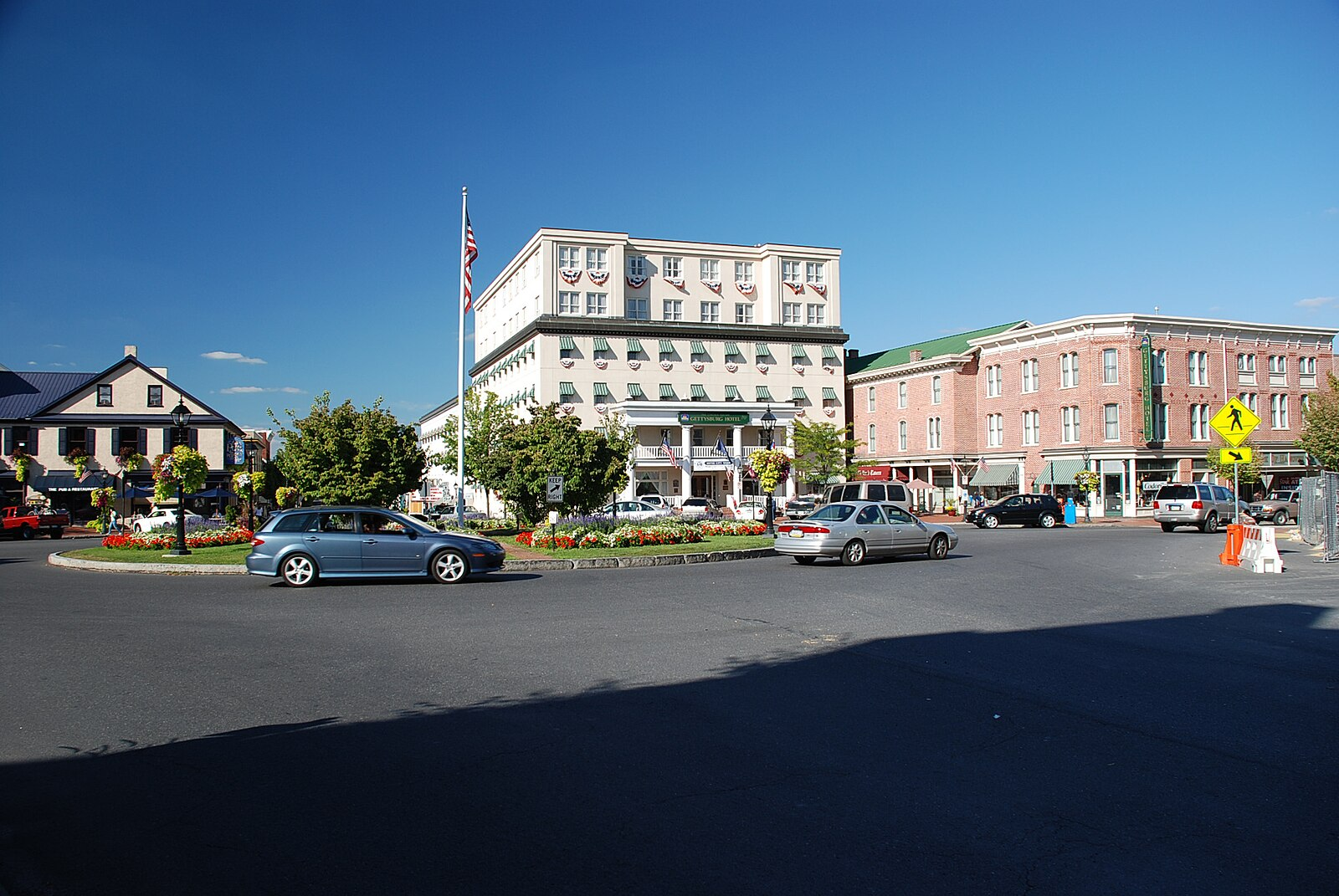
The Hotel Gettysburg stands at 1 Lincoln Square. Gettysburg’s Lincoln Square has been anchored for over two centuries by the inn that has worn many hats – from a humble 18th-century tavern to a Civil War hospital, from a Gilded Age grand hotel to a modern haunt for ghost-story seekers. The Gettysburg Hotel (once known as the McClellan House) stands as a living monument to the town’s tumultuous history, its walls bearing witness to both the heights of civic life and the depths of wartime suffering. Today it remains a bustling historic landmark, elegantly restored yet still whispering of the past. “Lincoln Square, in the heart of downtown Gettysburg, features the imposing Gettysburg Hotel and the Wills House where Lincoln stayed before delivering the Gettysburg Address,” notes one government caption – a reminder of just how entwined this building is with Gettysburg’s story.

To appreciate the full saga of the Gettysburg Hotel, let us journey through its many incarnations. Below is a timeline of key periods, names, and roles this storied structure has held over the years:
| Period (Year) | Name of Building | Key Uses and Events |
|---|---|---|
| 1797–1809: Early years | Scott’s Tavern | Built 1797 by James Scott as a tavern/inn on the town square. Hosted travelers and local gatherings in a young Gettysburg. |
| 1809–1846: McClellan era (Part I) | The Indian Queen (also called Little Indian Queen) | Purchased 1809 by William McClellan (ex-York County Sheriff) who renamed it “Indian Queen”. A popular stagecoach stop and social hub for statesmen and townsfolk. |
| 1846–1863: McClellan era (Part II) | McClellan House | Taken over by the McClellan brothers in 1846 and renamed in their honor. Operated under this name during the Civil War. A centerpiece of civic life in Gettysburg; e.g. winter 1862–63 the 10th NY Cavalry’s quartermaster rented rooms here for military business. |
| July 1863: Civil War | McClellan House (field hospital) | Battle of Gettysburg: The hotel was commandeered as a makeshift hospital. Its parlors became surgery wards run by volunteer nurses (the Sisters of Charity) caring for wounded soldiers. Suffering and death filled the rooms as battles raged nearby. |
| Post-1863: Recovery | McClellan House | After the battle, it continued serving as a hotel. In Nov. 1863, the hotel overflowed with visitors during the Soldiers’ National Cemetery dedication – guests even slept in lobbies and the bar due to lack of space. President Lincoln stayed across the street at the Wills House, but the McClellan House was central to the town’s post-battle commemorations. |
| 1890s: Gilded Age renovation | Gettysburg Hotel | New owner in the 1890s undertook a complete renovation and rebranded it “Hotel Gettysburg.” The old tavern structure was largely replaced by a grander brick building on the same site. Boasted early amenities like electric lights, steam heat, and hot/cold baths – “nearly unheard of in other hotels” then. Became a luxury destination for tourists, dignitaries, and celebrities. |
| Early–Mid 20th century: Heyday | Hotel Gettysburg | The hotel gained national reputation for fine dining and hospitality. It was “the traditional stopping place of statesmen, businessmen and visitors… [and] the center of most all community activities,” according to mid-century promotional text. In 1925, owner Henry Scharf even expanded it by building the adjacent Majestic Theater as part of the hotel complex Notable guests included President Dwight D. Eisenhower, who used the hotel as a temporary White House in 1955 while recovering from a heart attack at his nearby farm. |
| 1960s–1980s: Decline & fire | Hotel Gettysburg (closed) | After Eisenhower and First Lady Mamie became the final guests in 1964, the hotel closed. It was partially used as apartments, then sat empty. A devastating fire in 1983 gutted much of the interior. The proud old building stood as a burned-out shell on Lincoln Square through the 1980s. |
| 1991: Restoration | Gettysburg Hotel (Best Western) | Through a partnership including Gettysburg College and local preservationists, the hotel was rebuilt and magnificently restored, reopening in 1991. It retained its historic façade and even incorporated the 1814 Gettysburg National Bank building as its grand ballroom (complete with an old vault door on display). Joined Historic Hotels of America in 2003. |
| 2010s–Present: New chapter | Hotel Gettysburg (independent) | Continues as a premier hotel with 119 rooms, owned by Gettysburg College. A 2024 renovation “reclaimed its original identity” by officially rebranding from “Gettysburg Hotel” back to “Hotel Gettysburg.” Modern amenities now blend with historic charm – and a healthy dose of ghost lore keeps things interesting for guests. |
From Frontier Tavern to Town Social Hub (1797–1840s)
The story begins in 1797, when local entrepreneur James Scott built a modest tavern on Gettysburg’s town square. Back then Gettysburg was just a fledgling crossroads, and Scott’s Tavern – as it was called – offered food, drink, and lodging to travelers journeying along dusty turnpikes. With its location at the hub of Lincoln Square, the tavern quickly became a gathering place for townspeople as well, hosting community meetings and serving as a social center in an era when inns doubled as public halls.
In 1809, Scott’s Tavern passed into the hands of a new owner with a memorable pedigree. William McClellan, a former sheriff of York County, purchased the establishment and gave it a catchy new name: The Indian Queen (sometimes affectionately called the “Little Indian Queen”). Why the exotic name? Tavern names in that era often aimed to be colorful and inviting. Under McClellan’s proprietorship, the inn thrived. It was “already a popular stop for travelers and statesmen alike” by the early 19th century, catering to stagecoach passengers and visiting dignitaries. We can imagine its oil lamps casting a glow on rough-hewn tables, as locals and strangers shared pints of ale and news of the day.
(If you’re wondering whether William McClellan has any relation to another haunted spot in Gettysburg—the Jennie Wade House, half of which was inhabited by John and Georgia McClellan—the answer is yes! John Louis McClellan, Jennie Wade’s brother in law, was the grandson of William McClellan.)
The McClellan family’s imprint on the hotel would only deepen. By the 1840s, William McClellan’s sons (or relatives – known to history simply as “the McClellan brothers”) took over management. In 1846 they rechristened the establishment the McClellan House, immortalizing the family name on the lintel. This period saw the hotel’s stature grow alongside Gettysburg’s. The town, chartered in 1806, was developing into a regional center, and the McClellan House was its unofficial town salon. Local government officials, lawyers, and businessmen frequented the place; it likely hosted civic meetings, political caucuses, and social balls in its parlors.
One anecdote from this era highlights the hotel’s role in pre-Civil War military affairs: During the winter of 1862–63, the Union Army’s Tenth New York Cavalry encamped near Gettysburg, and their quartermaster “took a room at the hotel which he used for the transaction of business.” Even before the great battle, the McClellan House was entwined with the military currents of the day.
Blood on the Floors: The Hotel as a Civil War Hospital (1863)
Everything changed in July 1863. The peaceful routines of the McClellan House were shattered by the Battle of Gettysburg, the cataclysmic clash that engulfed the town for three days. As Confederate and Union armies turned Gettysburg into a war zone, “any occupiable building was fair game” to be seized for use as a field hospital. The centrally located McClellan House – with its sturdy walls and ample rooms – was quickly commandeered to treat the wounded.
During and immediately after the battle, the hotel’s parlors and chambers became scenes of almost unimaginable suffering. Wounded Union soldiers (and likely some Confederate prisoners) were carried or dragged into the building from the bloody streets and fields. The dining room tables turned into operating tables. Blood literally soaked the wooden floorboards; amputated limbs piled up outside. Death was a frequent visitor – and as later legend would have it, perhaps an eternal resident (as we’ll see in the ghost stories).
Local civilian volunteers and religious orders rallied to help in this impromptu hospital. In the aftermath of battle, the hotel “parlors were turned over to the Sisters of Charity who nursed the wounded soldiers.” These Catholic nuns from nearby Emmitsburg’s order of St. Vincent de Paul moved in, converting elegant guest rooms into infirmaries. Accounts from town residents describe the scene: rows of injured men laid out on every available surface, the air thick with the smell of blood, chloroform, and fever. The Sisters, assisted by Gettysburg citizens, offered what comfort and medical care they could. One persistent legend even identifies a particular nurse – “Rachel” – who supposedly perished during this time (though no historical record confirms a namesake, as we’ll later discuss in the ghost lore).
For weeks after the battle (which ended July 3, 1863), the McClellan House continued as a convalescent hospital. When President Abraham Lincoln came to town that November to dedicate the National Cemetery, the hotel was still recovering from its ordeal. Lincoln did not stay at the McClellan House – he famously lodged across the street at attorney David Wills’ home – but the hotel was directly in the middle of the commemorative events. In fact, the influx of visitors for the Gettysburg Address ceremonies overwhelmed every hostelry in town. The Gettysburg Hotel (still called McClellan House then) “was so full that people had to sleep in the lobbies and the bar” during the November 1863 dedication week. One imagines the contrast: a few months prior, those same parlors held rows of wounded men; now healthy crowds jostled for space, coming to honor the dead and hear Lincoln’s immortal words just yards away.
Though no detailed architectural descriptions from 1863 survive, we know the McClellan House at that time was a mix of brick and wood structures, likely two or three stories tall. It bore a few battle scars of its own – some Gettysburg buildings were hit by stray shells or bullets, and while the hotel’s exact damage is unrecorded, nearby structures were pocked with bullet holes. What the McClellan House certainly retained were the psychological scars of Gettysburg’s horror. Such eerie sentiments would fuel ghost stories in years to come, but first the hotel had to enter a new era of rebirth.
Gilded Age Transformation and Civic Prominence (1860s–1910s)
In the decades following the Civil War, Gettysburg evolved from a war-torn village to a living memorial – a place of pilgrimages for veterans and tourists. The hotel, at the town’s very center, evolved as well. The McClellan House name stuck until the late 19th century, but by the 1880s its facilities were aging and perhaps not up to snuff for the wave of Victorian-era travelers. Enter a new owner in the 1890s who envisioned a grand transformation. This proprietor undertook a top-to-bottom renovation. In fact, the old structure was largely torn down in 1895 to make way for a “new Hotel Gettysburg” on the same site. The choice of name was deliberate – “Hotel Gettysburg” – aligning the business proudly with the famous town itself.
When the Gettysburg Hotel opened its doors, it was the modern marvel of its day. Contemporary accounts boast that “as the 20th century began, the hotel had its own fine dining restaurant, electric lighting, steam heating, and hot and cold baths”, luxuries that were “nearly unheard of in other hotels in Pennsylvania or much of the rest of the country.” The new edifice was a stately brick building fronting directly onto Lincoln Square, likely three stories high initially. Postcards from the early 1900s show a neoclassical façade with a columned entrance and large windows – a fittingly grand presence at the town center.
This investment paid off. The Gettysburg Hotel quickly established a reputation for elegance. It became “one of the Nation’s better hotels,” enjoying a national reputation for excellent food,” as one 1950s postcard later described it. In the late 19th and early 20th centuries, distinguished guests were a common sight: governors, generals, business magnates, and the occasional celebrity passed through. Gettysburg’s battlefield had become a tourist attraction and reunion site (especially by the 50th anniversary in 1913), and the hotel was the premier lodging for VIPs.
Equally important, the Gettysburg Hotel remained a local civic hub. It hosted banquets, balls, and club meetings in its banquet halls. An advertisement from the 1910s might mention Masonic lodge dinners or borough council receptions at the hotel. In 1925, the hotel’s owner Henry Scharf even added an adjoining Majestic Theater (a grand movie and performance theater) to expand the entertainment options for guests and townspeople.
By the mid-20th century, the Gettysburg Hotel was truly in its prime. The postcard above, mailed in 1958, notes the hotel’s prime location “directly on the Square at the intersection of U.S. Routes 15 and 30” and “the modern facilities offered for the comfort and entertainment of its guests.” “The center of most all community activities,” and host to a “long list of distinguished patrons,” the hotel took justified pride in its heritage. One can imagine the lobby in the 1930s–50s, adorned with Civil War paintings and comfortable settees, where local civic leaders gathered for coffee and tourists chatted with old veterans swapping battle stories. Photographs from that era show uniformed bellhops out front and the marquee of the Majestic Theater next door lighting up the night – truly the glory days of a small-town American grand hotel.
Presidents, Closures, and Restoration (1950s–1990s)
In October 1955, President Dwight D. Eisenhower – who had retired to a farm in Gettysburg – suffered a heart attack. During his recovery, the Gettysburg Hotel played a role unique in American history: it served as a temporary “White House” of sorts. The ailing Eisenhower moved into a suite at the hotel (which was equipped with secure phone lines) while he convalesced at his farm and nearby hospital. For several weeks, presidential aides and Secret Service occupied rooms, and Ike conducted limited business from the hotel. The general manager at the time, Henry D. Scharf (son of the earlier owner), personally catered to the First Family’s needs. It’s even said that Mamie Eisenhower so enjoyed the hotel’s hospitality that she redecorated one of the suites during their stay. This illustrious episode capped the hotel’s 20th-century prominence.
By the early 1960s, however, change was in the air. America’s new interstate highways were bypassing small downtowns, and mid-century travelers increasingly favored motor inns on the outskirts. The Gettysburg Hotel’s business declined. In 1964, the venerable hotel closed its doors – at least as a hotel. Fittingly, Dwight and Mamie Eisenhower were the last official guests to check out, shortly before operations ceased. For a time, the structure found use as apartments and shops, but maintenance lagged. The once-grand interiors faded and peeled.
Then came 1983, when a catastrophic fire broke out in the vacant building. Locals still recall the spectacle of flames gutting the upper floors and water from firefighters flooding the old ballroom. “The abandoned old building suffered a fire in 1983,” recounts one history, “but was rebuilt as the Gettysburg Hotel in 1991, better than ever.” Indeed, the burned hulk might have been demolished if not for preservation efforts. Gettysburg’s community and Gettysburg College stepped in, recognizing that this corner of the Square was too important to lose. A plan was devised to restore and reopen the hotel, leveraging state and private funds.
After nearly eight years of careful planning and construction, the Gettysburg Hotel was reborn in 1991. The developers painstakingly reconstructed historical details from photographs and surviving elements. They even integrated the adjacent Gettysburg National Bank building (circa 1814) into the hotel complex – today the hotel’s Grand Ballroom is the old bank lobby, still sporting its 28-foot hand-painted ceiling and a massive vault door from 1814 on display. Modern mechanical systems and an extra wing of rooms were added behind the historic façade, ensuring the hotel met late-20th-century expectations without altering its 19th-century outward appearance.
The revitalized Gettysburg Hotel reopened under the Best Western chain, but still oozed historic charm. It quickly reestablished itself as the social center of town – once again hosting weddings, holiday balls, and dignitaries (in 1997, for instance, President Bill Clinton lunched here during a battlefield commemoration event). In 2012 the hotel left the chain and returned to independent status, and by 2024 it even restored its old name “Hotel Gettysburg” to reinforce its heritage. Gettysburg College remains the owner, ensuring the property’s preservation.
Walking into the lobby today, guests are greeted by polished woodwork, a grandfather clock, and displays of Civil War artifacts. But alongside the palpable history, there is another presence frequently noted – something (or someone) unseen yet uncannily felt. This brings us to one of the hotel’s most intriguing layers: the ghost stories that have attached themselves to the Gettysburg Hotel like lingering shadows.
Ghosts of the Gettysburg Hotel: Legends in the Halls
Gettysburg College owns both Pennsylvania Hall and Hotel Gettysburg. If walls could talk, the Gettysburg Hotel’s might scream – or so the ghost hunters say. With so much tragedy imprinted on its past, it’s little wonder that the hotel has earned a reputation as one of the most haunted spots in Gettysburg. The rise of the hotel’s ghost lore is a relatively modern phenomenon. Locals have long whispered about strange occurrences, but it wasn’t until the late 20th century (when tourism in Gettysburg shifted to include paranormal tourism) that these tales became widely told. By the 1990s, guided candlelight “ghost walks” were popular in town, spurred by publications like Mark Nesbitt’s Ghosts of Gettysburg (first published in 1991). Since then, ghost tour companies have eagerly incorporated the Gettysburg Hotel into their itineraries, spinning spooky yarns to wide-eyed visitors.
So, who – or what – is purported to haunt the hotel’s halls? Several recurring characters emerge in the legends:
- “Rachel,” the Civil War Nurse: By far the most famous ghost associated with the hotel, Rachel is said to be the benevolent spirit of a young nurse who tended wounded soldiers in 1863 and never quite left. Guests and staff alike have reported uncanny incidents blamed on Rachel: dresser drawers found opened and rifled through, as if a nurse were searching for bandages; lights turned on and off by unseen hands; the sound of rustling skirts swishing along the empty hallway at night. One commonly cited account describes a guest waking up to find a slim woman in old-fashioned attire standing over the bed, “performing a ghostly wellness check,” before vanishing. Rachel’s ghost is usually described as benign – a caregiver at heart. Some have even claimed to see her on the street outside the hotel, “possibly looking for soldiers to tend to,” as one tour puts it. The true identity (and even existence) of Rachel is a mystery – no nurse by that name is recorded among the Sisters of Charity or local women at Gettysburg. Her legend likely emerged from the general history of nurses at the hotel and was given a name for storytelling convenience. Still, she has become an iconic figure in Gettysburg’s ghost lore.
- The Dancing Couple in the Ballroom: The hotel’s elegant ballroom has its own spectral dancers. Numerous witnesses have described seeing a lone woman in a flowing Civil War-era gown twirling gracefully across the empty ballroom floor. Often she appears to be dancing with an invisible partner. Other times, an apparition of a man in Union uniform is seen accompanying her in a waltz. The identity of this phantom pair is unknown – they’re sometimes referred to simply as “the Lady in White and the Soldier.” Some speculate the woman might be another iteration of the nurse (enjoying a brief respite from duty in the afterlife), or perhaps a guest who died tragically at the hotel. Regardless, the “ghost of a woman seen dancing in the ballroom” has become a staple ghost tale. Staff reportedly have heard the faint strains of nonexistent music and the soft swish of a gown when the ballroom is dark and locked for the night.
- The One-Armed Soldier (a.k.a. James): Another commonly reported apparition is that of a lone Union soldier who roams the corridors. Tour guides often tell the story of Private James Culbertson of the Pennsylvania Reserves – a real soldier who was brought to the hotel, mortally wounded by a gunshot, and who allegedly insisted on returning to his unit until his last breath. According to the legend, James’s “faint, pale apparition, dressed in Union attire, with a bloody hole in his torso” has been seen in certain rooms. Guests who encounter him report a lingering cold spot and even the sound of a hoarse voice saying something like “I’m ready to go back to the fight.” Whether or not James Culbertson is the true name (it adds a nice ring of specificity to the tale), the motif of a dutiful soldier ghost is prevalent. Some versions say this soldier checks on doors as if still on guard duty. He typically disappears when approached – a fleeting sentinel from beyond the grave.
- Miscellaneous Haunts: The hotel has plenty of other ghostly anecdotes. There’s talk of poltergeist-like pranks – objects moving on their own, faucets turning themselves on, televisions flickering. One former employee recounted being alone in the kitchen and seeing a serving cart roll clear across the floor by itself, travel about twelve feet, then inexplicably turn and come to a stop. Others have heard disembodied footsteps following them on the grand staircase, or felt a phantom hand brush past them in their rooms at night. The front desk keeps an informal log of guest reports – it’s not uncommon for visitors to check out bleary-eyed in the morning, admitting they got little sleep due to unexplained bumps in the night.
The ghost stories truly took off in the tourism boom of the 1990s and 2000s. What began as local lore was soon codified by professional ghost tour companies in their scripts. By now, the Gettysburg Hotel’s supernatural side is part of its identity. It has been featured on television shows about haunted places, with paranormal investigators setting up EVP (Electronic Voice Phenomena) recorders in Room 312 (rumored to be Rachel’s favorite) and heat-sensing cameras in the ballroom. Ghost enthusiasts rank it among “the most haunted hotels in Pennsylvania”, and staff have become so accustomed that “paranormal activity is so commonplace that the staff barely flinch when you mention it.” In October, around Halloween, the hotel often sees a spike in bookings from ghost-hunters hoping for a glimpse of Rachel or the dancing lady.
It’s worth noting that commercialization plays a role in these legends. Ghost tour websites and brochures eagerly embellish the stories – after all, a good ghost story is good for business. The Gettysburg Hotel’s ghosts have been woven into the town’s wider haunted tapestry, which includes the likes of the Farnsworth House and Jennie Wade House. Some skeptics might argue that the tales have grown taller with each retelling. But even cynical guests have found themselves with goosebumps during an overnight stay. As one travel writer put it, “For those who believe, it’s a paranormal hotspot. For those who don’t – well… spend a night here and get back to us.”ghostcitytours.com
An Enduring Landmark at Lincoln Square
Few buildings can claim a life as eventful as the Gettysburg Hotel. From its beginnings as Scott’s Tavern in 1797 serving early American wayfarers, through its McClellan House era witnessing a nation’s greatest trial, to its ascendance as the Hotel Gettysburg, a beacon of hospitality and later a subject of ghostly fascination – this structure has mirrored the fortunes of its town and nation. It sheltered community dances in one generation and amputations in the next. It welcomed generals and presidents, then fell silent and derelict, only to rise again.
Today, as one stands in Lincoln Square, the hotel remains a physical centerpiece of Gettysburg. The traffic roundabout bustles with cars; tourists snap photos of the building’s historic marker (which proudly proclaims “Est. 1797”). The David Wills House, now a museum, sits just across, forever linking the hotel to Lincoln’s Gettysburg Address. Inside, the One Lincoln restaurant (named in honor of that legacy) serves up modern farm-to-table cuisine amid decor that includes Gettysburg Address text on the wallpaper. Couples celebrate weddings under the same roof where Civil War nurses once prayed over dying boys.
In short, the Gettysburg Hotel is a living narrative. Each layer – tavern, hotel, hospital, haunted inn – adds depth to its character. For history buffs, a stay here is an immersion: you might sleep in a room where a general once plotted or where a soldier drew his last breath. For the curious who relish a good ghost story, the hotel does not disappoint – you might just find that a gentle tap on your shoulder at midnight has no earthly explanation. And for the local community, the hotel remains what it long has been: a proud landmark and gathering place at the heart of Gettysburg, a town that itself represents so much in America’s past.
As the hotel’s current managers like to say, here “history never checks out.” The Gettysburg Hotel’s walls indeed talk – through carefully preserved history and, if you believe, through the whispers of those who have never left. It stands not just as a building but as a storyteller, inviting each visitor to become part of its ongoing tale. And whether you come for comfort or curiosities, civic lore or spectral lore, the Gettysburg Hotel offers a stay imbued with the ambiance of ages. In the very center of Lincoln Square, past and present converge – and even the otherworldly, it seems, may dance by the chandelier light.
Leave a Reply