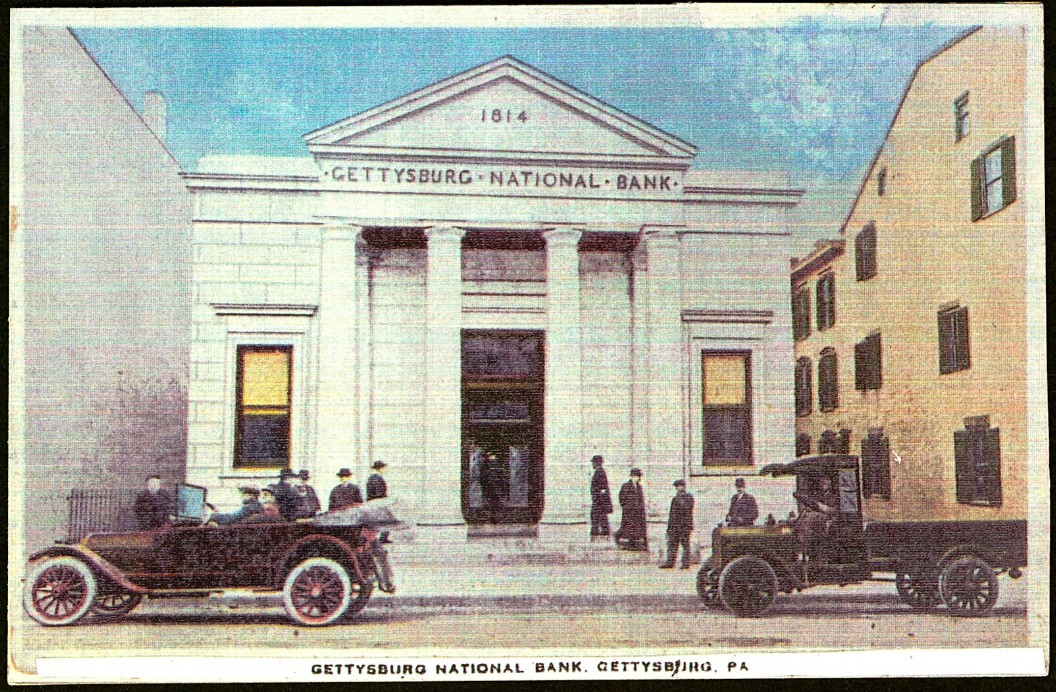
The names of people associated with the Bank of Gettysburg, Gettysburg’s first bank, include surnames even casual students of the town would recognize: James Gettys, Jacob Eyster, John McConaughy (father of David McConaughy), and various others. The bank’s original building (now part of the Gettysburg Hotel) was in the famous square (or diamond, as many call it) at the hub of town (a short walk from the home of David Wills). The bank was a critical financier throughout the town’s history.
Founding and early history (1814–1860)
The Bank of Gettysburg was chartered in 1814 as the sole bank for Adams County. It opened on what is now called Lincoln Square in Gettysburg (the original building survives as today’s Gettysburg Hotel grand ballroom). Early leaders included President John McConaughy (elected 1820) and directors like George Smyser, Samuel Lilly and even Thaddeus Stevens (elected in 1830). By mid-century the bank was Gettysburg’s principal financial institution; for example, local magnate George Swope (then president of the bank) was the town’s wealthiest resident by 1860. (Throughout the 1800s, the board comprised prominent local citizens and merchants.)

Civil War and national charter (1860–1870): In June 1863, as Confederate forces approached Gettysburg, the Bank of Gettysburg evacuated nearly $100,000 of specie and bonds to Philadelphia for safekeeping. It closed during the Battle of Gettysburg but reopened on July 27 without suffering any financial losses. Soon after, under the new National Banking Act, the institution reorganized as the Gettysburg National Bank. Stockholders began rechartering in late 1863, and the new national charter was issued in December 1864org. Its first board under the national charter (elected January 1865) included George Swope, William McSherry and others.
Late 19th and early 20th century (1870–1926)

The Gettysburg National Bank remained locally owned and run by successive generations of prominent families. For example, in 1880 Dr. John B. Swope (son of George) was bank president, and in 1896 officer titles included John A. Swope and William McSherry Jr. (both of established local families). Throughout this era the bank expanded its services (it joined the new Federal Reserve system in 1914) and financed regional growth. In 1926–27 the bank absorbed the town’s Lincoln Trust Company. At the end of 1926 it merged Lincoln Trust into its operations, transferring over $500,000 of assets under armed guard into the Gettysburg vault. The enlarged bank added six former Trust Co. directors to its board, growing from 12 to 18 members.
20th century expansion and mergers (1930–1992)
After 1930 the bank continued to grow regionally. Under longtime president C.A. Wills the bank opened new branches (for example on West Street in 1961) and acquired nearby banks. In 1963 Gettysburg National Bank merged with Biglerville National Bank (its branch in neighboring Littlestown). By mid-century the bank managed trusts and assets for far beyond Gettysburg. However, the Gettysburg National Bank’s independent era ended in 1992: on October 23, 1992 it was merged into CCNB Bank, N.A. (Camp Hill, PA). (Two years earlier CCNB had acquired Gettysburg’s holding company.) CCNB itself was shortly thereafter acquired by PNC Financial; by 1993 all CCNB branches, including Gettysburg’s, were rebranded PNC.
Legacy – building and successors
The original 1814 bank building survives as Gettysburg’s historic hotel. As noted by the Gettysburg Hotel, “The Grand Ballroom [was] originally the Gettysburg National Bank built in 1814,” complete with the old vault door (dating back to the bank’s opening) still on display. Thus the prime bank location remains part of Gettysburg’s downtown. The bank’s business lineage lives on through its successors: after 1992 its branches became CCNB (and then PNC) branches. In short, while the “Gettysburg Bank” name ceased with the 1992 merger, its 19th-century vault and legacy continue as part of Gettysburg’s heritage.
Leave a Reply