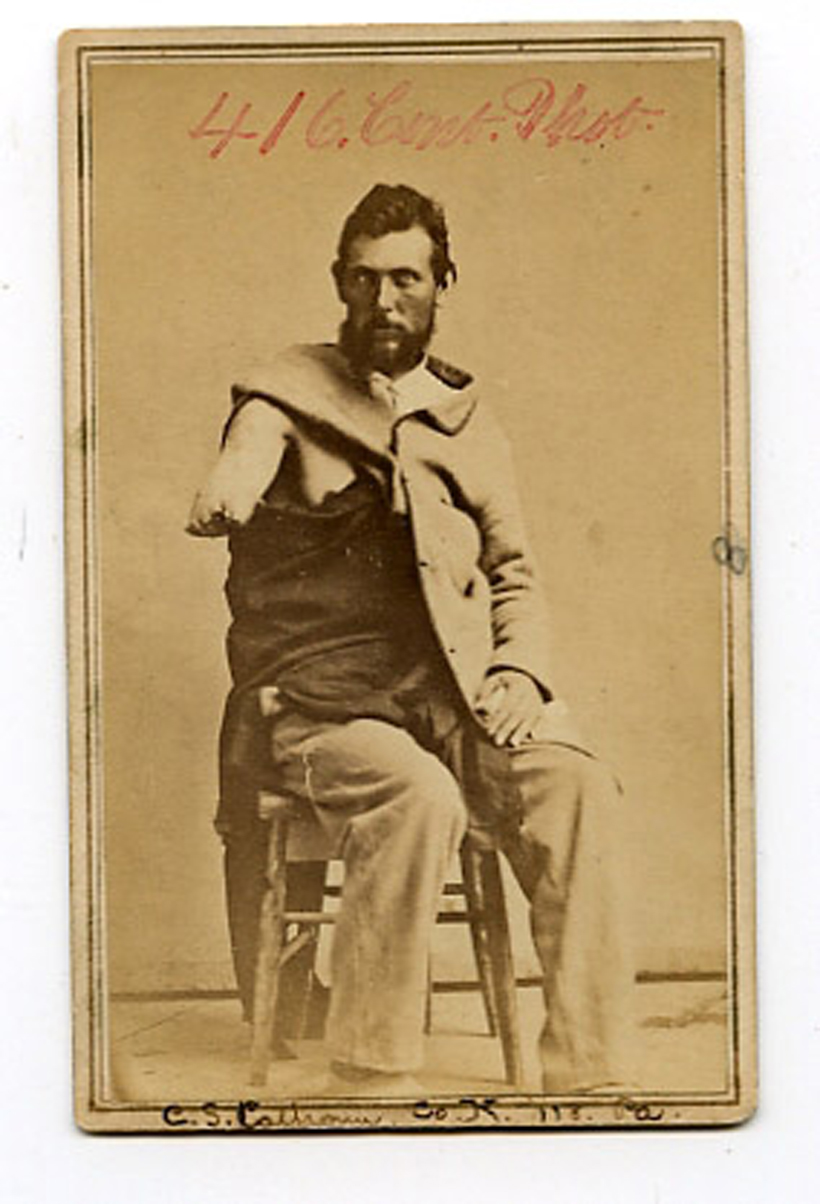
To understand John T. Weikert, it helps to know something about war trauma and family violence. One of the underreported aspects of the Civil War was the number of veterans who were scarred both physically and mentally. Harrowing images exist that show us disfigured men who had to struggle with disabilities for the rest of their lives. Less reported were the mental traumas that these men wrestled with. After the war, the Weikert family intersected with the law over issues of adultery, domestic violence, and attempted murder. It’s hard to say for sure all the causes from a century and a half later, but it’s almost certain that the strains of war had at least some role.

John Thomas Weikert was born on February 23, 1838 in Carroll County, Maryland. He was the son of George Weikert and Catherine (Grove) Weikert. In mid-1838 his family moved north to Adams County, Pennsylvania, where his father purchased a 78-acre farm near Gettysburg (just north of Little Round Top) in 1852. During the Battle of Gettysburg in 1863, the elder George Weikert’s farm was overrun and used as a field hospital, leaving the house filled with wounded and the yard “filled with graves.”
John’s own life would later be marked by violent incidents and legal troubles, suggesting a turbulent family environment. In the late 1850s John married Sarah Catherine Keefauver (1842–1919) of Maryland. The couple settled in Cumberland Township near Gettysburg, where John worked as a farmer and a carpenter; he was described as a “well-respected carpenter” in the community. They started a family and had several children. Their firstborn was daughter Emma Jane “Jennie” Sarah Josephine Weikert (b. 1860), who later married Charles Strausbaugh.
Jennie was at the center of a famous Gettysburg incident as a toddler (see below). John and Sarah’s other children included Charles Ellsworth Weikert (b. 1865), Albert Daniel Weikert (b. 1873), and Oliver Harvey “Harvey” Weikert (b. 1877). The family lived on a farm John built after the Civil War, adjacent to his father’s land. Notably, the John T. Weikert farm (a house and barn constructed in the 1870s) stood along a lane south of the Gettysburg battlefield, just across from the famed Wheatfield.
Civil War Service (1862–1865)
When the Civil War erupted, John T. Weikert enlisted to serve the Union. On August 7, 1862 – his daughter Jennie’s second birthday – he enlisted as a Private in Company B, 138th Pennsylvania Infantry. At age 24, he joined many other Adams County men in this regiment. The 138th P.V.I. was organized in late summer 1862 and initially served in the defenses of Washington, later joining the Army of the Potomac in Virginia.
Because the 138th was posted in Virginia in mid-1863, John did not fight at Gettysburg when battle came to his home area. His young wife Sarah and little Jennie were left on their farm during the battle’s second day, July 2, 1863 – an experience in which Sarah handed Jennie to a passing cavalryman to save the child from the crossfiret. Jennie was carried to safety, a story that became a local legend known as “Jennie’s Ride.”)
John saw considerable action with the 138th Pennsylvania. The regiment was engaged in the heavy campaigns of 1863–64. On November 27, 1863, during the Mine Run Campaign in Orange County, VA, Private Weikert was seriously wounded at the Battle of Payne’s Farm. He suffered a shattered right arm from a gunshot wound in that fight. The injury was severe enough that he was sent home to recover, and he spent an extended furlough in early 1864 recuperating. It is likely that he was formally discharged from the army due to his disability (contemporary records list him as having achieved the rank of Corporal by the end of his service). His wartime service totaled roughly a year and a half.
John Weikert’s military service entitled him to veteran status, but there were hints of post-war friction with fellow veterans. In mid-1884, Weikert applied to join the Grand Army of the Republic (GAR) – the Union veterans’ fraternal organization – but his application was rejected by the local post. The GAR rejection (his name appears in Department of Pennsylvania orders listing “applications for membership…rejected”) suggests that, despite honorable military service, John’s personal reputation in the community had become tarnished by that time. As seen below, by the 1880s he had been involved in multiple legal troubles which likely contributed to his alienation from some veteran circles.
Post-War Marriage Troubles and Estrangement
After his wounding, John returned to a family strained by conflict and rumor. He and Sarah experienced a serious estrangement in the late 1860s. According to family accounts, John accused his wife of infidelity during his wartime absence. In particular, the parentage of their son Charles, born in 1865, was questioned by John – the records of Charles’s birth were “murky,” leading John to suspect Sarah had conceived the child with another man while John was away. This led to a separation that lasted for several years after the war.
Despite the turmoil, John and Sarah eventually reconciled by the early 1870s. They renewed their marriage and went on to have two more sons: Albert (born 1873) and Oliver Harvey (born 1877). For a time, it appeared the family was back on stable footing. However, John’s personal struggles were far from over, and the aftermath of war – whether emotional trauma, physical pain from his wound, or lingering marital distrust – may have contributed to his later violent behavior.
Historical perspective: It is now understood that many Civil War veterans suffered from what we today recognize as post-traumatic stress disorder (PTSD) or other war-related mental health issues. Contemporary accounts describe veterans who became “uncontrollably violent” or erratic in the years after the war. In John Weikert’s case, a combination of psychological scars (he had seen intense combat and was severely wounded) and domestic turmoil could have fueled a propensity for violence. Nineteenth-century society had little understanding of combat trauma; behaviors we might attribute to PTSD – such as sudden rages or alcoholism – were often not formally documented, but “post-war lunatic asylum records are filled with veterans whose uncontrollable rage jeopardized their lives and those of family members.” Weikert’s post-war life fits this broader pattern of some veterans who, unable to fully reintegrate, engaged in destructive behavior.
Criminal Charges and Court Proceedings
John T. Weikert’s name appears repeatedly in the late 19th-century Adams County criminal records. He was involved in several serious legal cases between 1882 and 1902. The table below summarizes the key charges brought against him, based on court indices and contemporary reports:
| Date (Filed) | Charge | Details (Complainant/Victim) | Outcome |
|---|---|---|---|
| June 4, 1882 | Assault and Battery with Intent to Kill (Attempted Murder) | Weikert was accused of a violent assault upon his wife Sarah C. Weikert, allegedly with intent to commit murder. The complaint was sworn by Sarah herself and by his brother George W. Weikert, indicating that George (a Gettysburg police officer) intervened or witnessed the incident. | Outcome: The court records show the charge was filed; contemporary newspapers reported the case, but the final verdict/sentence is unclear from available sources. It appears John avoided a lengthy prison term, as he remained in the community afterward. (It is possible he was convicted of a lesser offense or reached some settlement, but no definitive record of the disposition has been found in the sources.) |
| Feb 22, 1884 | Abandonment of Wife and Child | John was charged with “abandoning his wife and minor child” – essentially a failure to support his family. The complaint was made by his wife Sarah C. Weikert. This charge came about two years after the 1882 assault case, suggesting the marriage had collapsed again; John had apparently deserted Sarah and their youngest children by this time. | Outcome: Likely bound over to court – such cases in that era could result in the husband being ordered to pay financial support or face a jail term. The specific court outcome isn’t recorded in the index. It’s known that by mid-1884 John attempted to join the GAR but was blackballed, implying community disapproval. Weikert’s relationship with Sarah remained poor; they lived apart after this point. (Sarah and the children may have relied on relatives or the county for support in his absence.) |
| Sept 2, 1902 | Assault and Indecent Assault | Weikert, at age 64, was accused of assaulting a local young woman named Hannah Miller. A man named Cornelius Bucher swore the complaint (possibly a law officer or a relative of the victim). The charges included ordinary battery and “indecent assault,” indicating the incident was sexual in nature but stopped short of rape. In the ensuing trial (Commonwealth v. John T. Weikert), Hannah Miller was the prosecutrix (complaining witness). | Outcome: Guilty. John T. Weikert was convicted on both counts of assault and indecent assault in late 1902【23†】. A contemporary newspaper report states: “In the case of Comm. vs. John T. Weikert, Hannah Miller prosecutrix, defendant was found guilty on the charges of assault and battery and indecent assault. Motion for a new trial made.” John’s lawyer did file a motion for a new trial, but there is no indication this was granted; it’s likely the conviction stood. He would have been sentenced sometime in 1903 – possibly to a term of imprisonment. (If so, it was probably served in county jail; by his advanced age, any jail term may have been relatively short.) He returned to Adams County life afterward, but his reputation was irreparably tainted. |
The above cases illustrate a pattern of domestic violence and instability. The 1882 incident was especially shocking: John Weikert nearly killed his wife in a fit of rage. Although details are sparse, the fact that his own brother (George W.) joined the wife in swearing out the warrant suggests the violence was severe enough to compel intervention even from within the family. Local newspapers likely reported on the attempted wife-murder, and it would have scandalized the Gettysburg community. The charge of desertion in 1884 shows that within two years of the assault, John had effectively abandoned his family, leaving them destitute – an offense that authorities did not take lightly in that era. Finally, the 1902 indecent assault case shows that even in old age, John’s violent tendencies persisted. He assaulted a woman young enough to be his daughter. Being found guilty of “indecent assault” – essentially a sexual assault – would have made John Weikert a pariah in the community.
Community Perception and Legacy
In the Gettysburg and Adams County area, John T. Weikert became notorious for his misdeeds. The progression of his court cases was likely followed in the local press (papers such as the Gettysburg Compiler and Star and Sentinel routinely published court dockets and trial results). Weikert’s repeated offenses – domestic abuse, family desertion, sexual assault – would have marked him as a local villain in the eyes of many. It is telling that fellow Civil War veterans ostracized him: the GAR Post in Gettysburg rejected his membership application in 1884. This was a time when Union veterans generally stuck together, but apparently Weikert’s character was held in such low esteem that his comrades would not have him in their ranks.
Within his family, John was largely estranged. It is hard to know what living arrangements they had. After 1884, Sarah is listed as “widow” in all but name in some records after the abandonment charge. In 1919, Sarah died at the home of her son in Kansas where she had apparently been living.

Sarah endured a difficult life but was remembered as one of the Gettysburg civilian women who heroically endured the battle and its aftermath.) Their daughter Jennie Strausbaugh evidently maintained a relationship with her mother and took her side. Jennie grew up and married in 1881; she remained in Adams County and had children of her own. There is no indication that John was close with his grandchildren. In fact, contemporary gossip may have connected John’s wartime absence and Sarah’s fidelity issues to the point that even the paternity of one child (Charles) was questioned within the family – an embarrassing legacy for all involved.
It’s worth noting that the Weikert surname was well-known in Gettysburg, but not usually for negative reasons. John’s father and his extended family were long-time locals; for example, the George Weikert farm (John’s childhood home) became an important landmark on the battlefield, and other Weikerts had respectable positions (his brother George W. as a lawman, and another relative, Jacob Weikert, had aided Union soldiers during the battle). John Thomas Weikert’s behavior therefore stood in stark contrast to the otherwise honorable Weikert family name, something local historians have occasionally remarked upon. One modern historian, reflecting on Gettysburg’s civilian stories, listed John’s failed post-war marriage as “one of the rarely mentioned casualties of war” – implying that his descent into violence was part of the hidden toll that the war exacted on individuals and families.
Final Years and Death
John T. Weikert suffered a stroke in late July 1916 that proved fatal. He died on July 29, 1916, aged 78, at his home in Greenmount, Adams County. According to his obituary, the stroke (“paralysis”) had struck him on the Wednesday prior to his death, and he never recovered. Despite his troubled life, local newspapers still noted his passing with a standard obituary. The obituary mentioned his Civil War service and that he was a resident of Greenmount, but it did not dwell on his crimes. He was survived by his wife Sarah (though they had possibly been living apart) and by several of his children and numerous grandchildren.
John was buried on July 31, 1916 in the Gettysburg National Cemetery, with a simple government-issued veteran’s headstone marking his grave (Section G, Pennsylvania Plot). Notably, he is not buried with his wife or near his children—Susan was buried in Kansas, though apparently only visiting when she died. The choice of burial in the National Cemetery is significant – it suggests that his military service, in the end, afforded him the honor of interment alongside fellow Union soldiers, something that perhaps he valued even if brother veterans had shunned him in life. His gravestone identifies him as “Pvt. John T. Weikert, Co. B, 138th P.V.I.,” tying him forever to the most honorable role he had: that of a Union soldier.
John’s death was not smooth, either. He left no will, and as such, legal procedures had to be followed carefully. When someone died in Pennsylvania in 1916, their estate generally had two parts:
- Personal property (livestock, household goods, farm equipment, tools, etc.)
- Real property (real estate) (the land and buildings themselves)
The law treated these separately: the administrator (usually a family member, if there was no will) sold the personal property, while real estate sales often required approval and oversight of the Orphans’ Court, especially if there were debts, multiple heirs, or a surviving widow to provide for.
John’s son Alfred was named administrator of the personal property, and he dutifully sold it. The notice (unironically) indicates that a 17-year-old horse is mild enough for “any woman to drive.” Oof.

The Orphans’ Court appointed administrators to sell the real estate.

Finally, Citizens’ Trust Company was appointed trustee of a fund of more than $2500 for the benefit of Sarah for the remainder of her life. This was Sarah’s legal widow’s share (“widow’s third”) of John’s estate, which the court required to be safeguarded.

Analysis: Possible Causes of Violent Behavior
Looking at John Thomas Weikert’s life in full, historians can identify several factors that might explain his pattern of violence and legal troubles:
- War Trauma and Health: John experienced brutal combat and a debilitating injury. Modern research into Civil War veterans shows that many suffered from psychological trauma that went unrecognized at the time. Symptoms of what we now call PTSD – irritability, anger outbursts, paranoia, depression, etc. – were often observed in veterans. Cases are documented of veterans becoming violent or “deranged” years after the war, sometimes threatening family members or landing in asylums. John’s shattered arm not only caused chronic pain but also ended his productive military career, which could have been a blow to his identity. Such physical and mental scars likely left him prone to anger and alcohol abuse (while direct evidence of his drinking is not recorded, it was very common for injured veterans to self-medicate with alcohol). All these could have lowered his inhibitions and contributed to domestic violence.
- Family Turmoil: John’s marriage was unstable from early on. The alleged infidelity by Sarah during the war deeply impacted him. Whether or not Sarah actually had an affair (and there is no definitive proof she did beyond John’s accusation), John clearly believed she had betrayed him. This betrayal narrative festered in his mind and poisoned their relationship. The immediate trigger of the 1882 attempted murder incident is not stated, but one can speculate it may have been a domestic argument – possibly John accusing Sarah of some wrongdoing or financial dispute – that escalated dangerously. Additionally, the Weikert family in general had a lot of drama (as seen with his siblings’ adultery case in 1877). It was a dysfunctional environment, and John’s resort to violence may have been learned or exacerbated by these family dynamics.
- Economic Stress and Social Pressure: After the war, John tried to farm and work as a carpenter, but his injury might have limited his capabilities. Financial stress can strain any marriage. Moreover, living in the shadow of Gettysburg’s tight-knit community, John’s personal failings were likely known to neighbors. Social stigma might have further alienated him, creating a vicious cycle of anger and acting out.
- Mental Illness: It cannot be ruled out that John T. Weikert had an underlying mental illness. Severe mood swings, paranoia (e.g. his possibly unfounded jealousy regarding Sarah), and lack of impulse control in his assaults are consistent with conditions like depression or personality disorders. Of course, 19th-century rural Pennsylvania had little recourse for mental health treatment. Unless someone was completely incapacitated and sent to an asylum, these issues were handled (or not) within the family. John never reached an asylum, but his behavior suggests he was not mentally well by modern standards.
In summary, John Thomas Weikert’s life is a case study in how the Civil War’s aftermath could wreak havoc on an individual and his family. He went from being a “well-respected” young craftsman and a Union volunteer to becoming a repeat offender in violent crimes. His legacy in the community was largely negative; he is remembered (when he is noted at all in local history) for the harm he caused rather than for his war service. His own descendants had to live under the shadow of his reputation. For instance, Jennie, his daughter, in telling the famous tale of her rescue during the Gettysburg battle, would understandably focus on the heroism of her mother and avoid discussing the later downfall of her father.
By the time of his death in 1916, John T. Weikert had outlived most of his Civil War comrades. He died quietly and was buried with military honors, closing a life that was as troubled as it was long. His story provides a window into the darker side of 19th-century veteran experience – including domestic violence, community censure, and the possible long-term psychological effects of America’s bloodiest conflict.
Leave a Reply