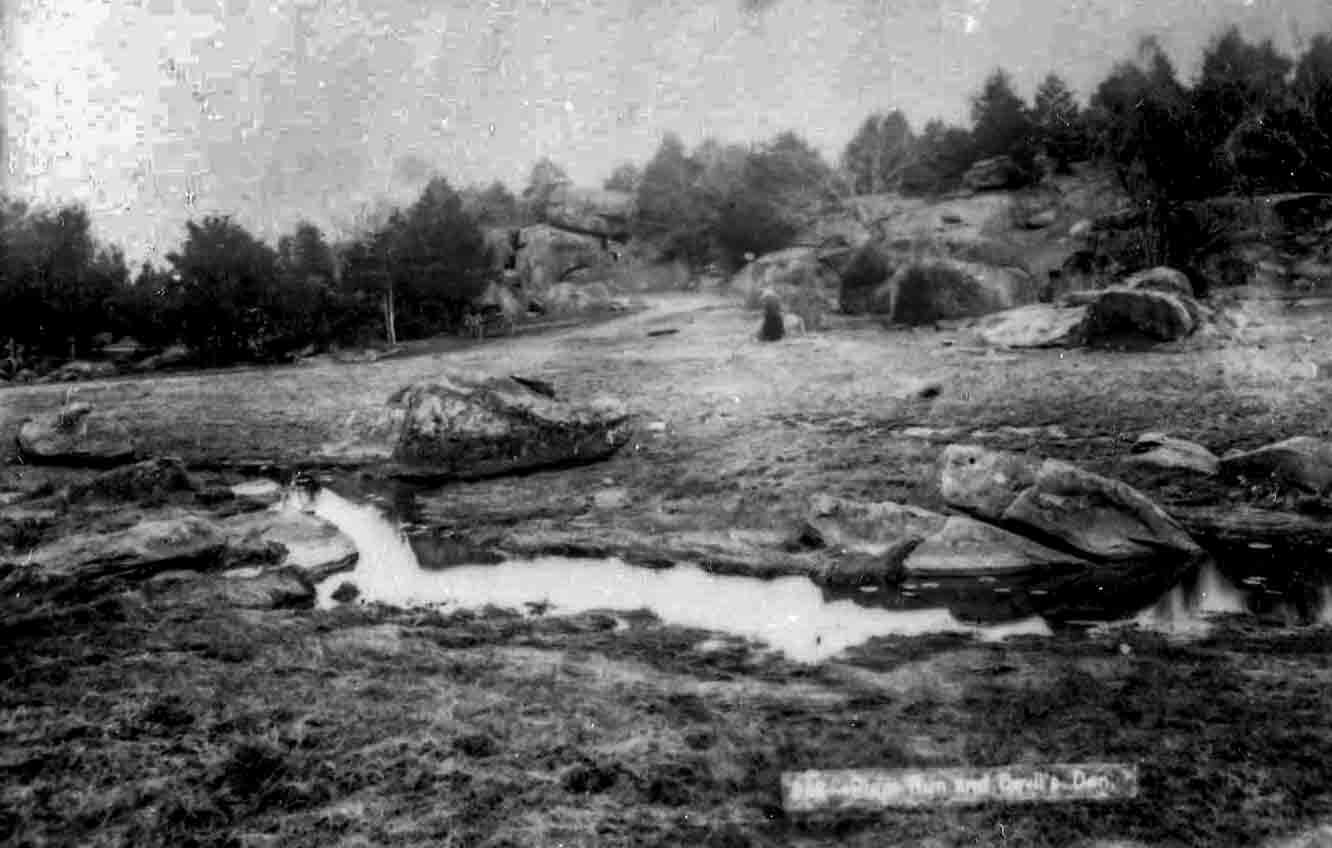
Gettysburg has the most haunted bridge in Pennsylvania, calls itself the most haunted town with the most haunted orphanage, and has house after house that is haunted. Quick, name the most haunted place on the battlefield. It’s obvious, right? The name says it all: Devil’s Den. While much of the lore around Devil’s Den descends from the battle, the huge rock formations inspired other worldly tales for years before.
On the afternoon of 2 July 1863, the second day of the Battle of Gettysburg, the jumble of pink granite boulders at the southern end of the battlefield became the scene of intense fighting. Known today as Devil’s Den, the rocky defile marked the left flank of General Dan Sickles’s extension of the Union line, and its capture by Confederate forces was one of their few successes that day. In the decades since, Devil’s Den has also become one of Gettysburg’s most enduring ghost stories. Visitors report phantom soldiers, headless riders, mysterious camera malfunctions, and a “helpful hippy” who guides lost tourists. These tales sit atop a real history of savage combat, photographic manipulation and pre‑war folklore. This article examines the facts and the legends.

Origins of the Name: Snakes, Spirits, and Superstitions
Early names and natural features
Prior to the Civil War, the area was simply known to locals as the “Big Rocks.” According to a mid‑19th‑century article in The Gettysburg Experience, diarist Sallie Myers Stewart recalled that early settlers described the rocks as infested with snakes. Farmers organized parties to destroy the snakes, yet “one large snake always escaped the hunt,” and the settlers called this snake “the Devil,” giving the place the name Devil’s Den. Other pre‑war lore varied: an article from Emerging Civil War notes that some locals attributed the name to a monstrous snake, others to a bear, and one story recorded by farmer Emanuel Bushman blamed raccoons attacking travelers. The multiplicity of explanations underscores that the sinister name existed long before the Civil War and may have arisen from natural hazards rather than the battle.
Legends of Native American battles
In the 1880s, local storyteller Emanuel Bushman wrote in the Gettysburg Compiler (using the pseudonym “Antique”) that Devil’s Den was the site of a great Native American battle. According to The History Bandits, he wrote that early settlers spoke of a clash between tribes at the rocks, and that ghosts and hobgoblins haunted the place; settlers claimed to hear Indian war whoops echoing at night. Historians have found no archaeological evidence for such a battle, but the tale demonstrates how the area’s forbidding landscape inspired supernatural interpretations long before Civil War tourism.
The Battle of Devil’s Den
The fight on July 2, 1863
Major General Daniel Sickles advanced his Union III Corps without orders to occupy higher ground such as the Peach Orchard, the Wheatfield, and Devil’s Den. In doing so, he created a salient that Confederate Lt. Gen. James Longstreet’s corps attacked. Longstreet’s division encountered stubborn resistance, but around 4 p.m. regiments from Texas, Arkansas, Alabama and Georgia launched a ferocious assault on the rocks. The 1st Texas and 3rd Arkansas attacked Devil’s Den from the west while the 44th and 48th Alabama pressed from the east. After intense fighting and heavy casualties, Ward’s Union brigade withdrew; Confederate sharpshooters occupied the boulder‑strewn den and fired on Union positions on Little Round Top.
Casualty figures were staggering. The Warfare History Network notes that Ward’s brigade suffered 732 casualties, with regiments losing around 150 men each. Confederate brigades also paid heavily—Robertson’s brigade lost 597, Anderson’s took 671 casualties, and Law’s and Benning’s brigades suffered about 500 casualties each. Overall, the engagement at Devil’s Den resulted in more than 1,800 Confederate and over 800 Union casualties, making it one of the bloodiest sectors of the battlefield. Despite capturing the rocks, the Confederate advance stalled; the Union line held on Little Round Top and Cemetery Ridge.
Staged photographs and the “Sharpshooter”
Devil’s Den is also known for one of the most debated photographs of the Civil War. Photographers Alexander Gardner and Timothy O’Sullivan visited the battlefield days after the fighting. According to the National Archives (NARA), they discovered a Confederate corpse and moved it about 40 yards from its original position to a more dramatic spot between the rocks, propping a sharpshooter’s rifle on the wall. They then photographed the body and titled the scene “Home of a Rebel Sharpshooter.” The same article notes that the gun in the photograph was likely a prop and not the dead soldier’s weapon.
The National Park Service corroborates that O’Sullivan first photographed the soldier where he fell and then, with Gardner, dragged the body to another location to produce the iconic image. Later research by historian William A. Frassanito exposed the staging, reminding modern readers to critically examine Civil War photographs. Several months after the battle, photographer Peter Weaver returned to Devil’s Den and posed men among the rocks pretending to be dead soldiers, underscoring that early images from the site were often manufactured for dramatic effect. American Battlefield Trust Education Director Garry Adelman has since argued that these two incidents have been over-generalized to suggest that far more Civil War-era photographs were staged, which is not supported by evidence.
Ghostly Accounts and Paranormal Phenomena
Devil’s Den’s violent history and eerie rock formations have fueled a rich tradition of ghost stories. Since the late twentieth century, the site has become a staple on Gettysburg ghost tours and a focal point for paranormal enthusiasts.
The “friendly phantom” or “Helpful Hippy”
One of the most famous apparitions is a barefoot, disheveled man wearing a floppy hat and ragged clothing. Multiple visitors report that this figure approaches them when they are lost and says, “What you’re looking for is over there,” before pointing in the direction and disappearing. A History.com article notes that tourists have captured mysterious figures in photographs and heard distant gunfire and screams; some have been guided by this barefoot man. HowStuffWorks recounts a story where the phantom approached a woman wearing a University of Texas sweatshirt, told her “First Texas,” and vanished. Ghost storyteller Mark Nesbitt, a former park ranger, recorded similar tales and argued that the ghost more closely resembles a 1st Texas Regiment soldier than a hippie. This association may explain why the apparition seems helpful to visitors from Texas.
Camera malfunctions and a vengeful sharpshooter
Visitors frequently report cameras and phones malfunctioning or batteries draining while at Devil’s Den. Nesbitt speculated that the ghost of the soldier whose body was moved for Gardner’s photograph might harbor animosity toward photographers. However, the American Battlefield Trust cautions that such anomalies may have natural causes—moisture, sunlight and battery issues—and notes that ghost tales around Devil’s Den only emerged in the 1990s as commercial ghost tours became popular. (Also, the parking area next to Devil’s Den has notoriously terrible cell reception.) Regardless, the phenomenon remains a staple of modern lore and adds to the site’s mystique.
Disembodied soldiers and phantom riders
Beyond the helpful phantom, visitors report seeing apparitions of soldiers in butternut or gray uniforms, sometimes appearing headless. US Ghost Adventures records a 1970s account of a woman who encountered a long‑haired man near the rocks; when she turned back to thank him, he had vanished. The same article mentions reports of a ghostly rider with accompanying gunfire and shouting. The History Bandits note that Bushman’s nineteenth‑century writings included a tale of a “man without a head” seen near the Emmitsburg Road; John Burns and Bushman’s brother Michael purportedly witnessed this apparition in 1832. This early ghost story predates the battle, suggesting that the area’s haunting reputation was well established.
Native American spirits and the “Battle of the Crows”
Some ghost tour narratives reference an alleged Native American battle called the “Battle of the Crows.” US Ghost Adventures claims that early settlers heard war whoops and saw ghostly Indian chiefs wandering the den. These stories derive largely from Emanuel Bushman’s writings and have little historical basis, but they add another layer of supernatural intrigue to the site.
Skepticism and Historical Context
Not all historians or park officials accept the paranormal claims surrounding Devil’s Den. The American Battlefield Trust argues that ghost stories are modern embellishments largely absent before the 1990s, when commercial ghost tours popularized them. Many of the reported phenomena—battery failures, misty photographs—can be explained by natural factors. Even the helpful phantom’s connection to the 1st Texas Regiment could be a case of visitors interpreting ambiguous encounters through the lens of ghost lore.
Nevertheless, the popularity of these stories reflects a broader human desire to connect with the past. The bare rocks of Devil’s Den witnessed intense suffering, and visitors often feel a palpable weight there. Whether the sensation arises from residual trauma, cultural storytelling, or imagination, it contributes to the visitor experience.
Visiting Devil’s Den Today
Devil’s Den is part of Gettysburg National Military Park and is open to visitors. The site features large boulders and trails, and interpretive signs explain the battle’s events. Because people sometimes injure themselves climbing the rocks, the National Park Service occasionally restricts access for safety and rehabilitation. Visitors should respect the landscape, avoid removing artifacts and stay on marked trails.
For those interested in ghost tours, numerous private companies offer night‑time walks that include Devil’s Den. These tours often recount the helpful phantom, the sharpshooter’s ghost and Bushman’s stories. While such tales are compelling, they should be consumed with an understanding of their speculative nature.
Conclusion
Devil’s Den occupies a unique place in Gettysburg’s cultural landscape. Its pre‑war reputation for snakes and spirits, the ferocious combat of 2 July 1863, and the staged photographs that shaped public memory all contribute to its aura. Modern ghost stories—from the barefoot phantom pointing the way to headless riders—reflect both historical trauma and the human penchant for storytelling. Whether one views the den as a sacred battlefield, a geological curiosity or a haunted hotspot, its legacy endures as a testament to the interplay between history and myth.
Leave a Reply