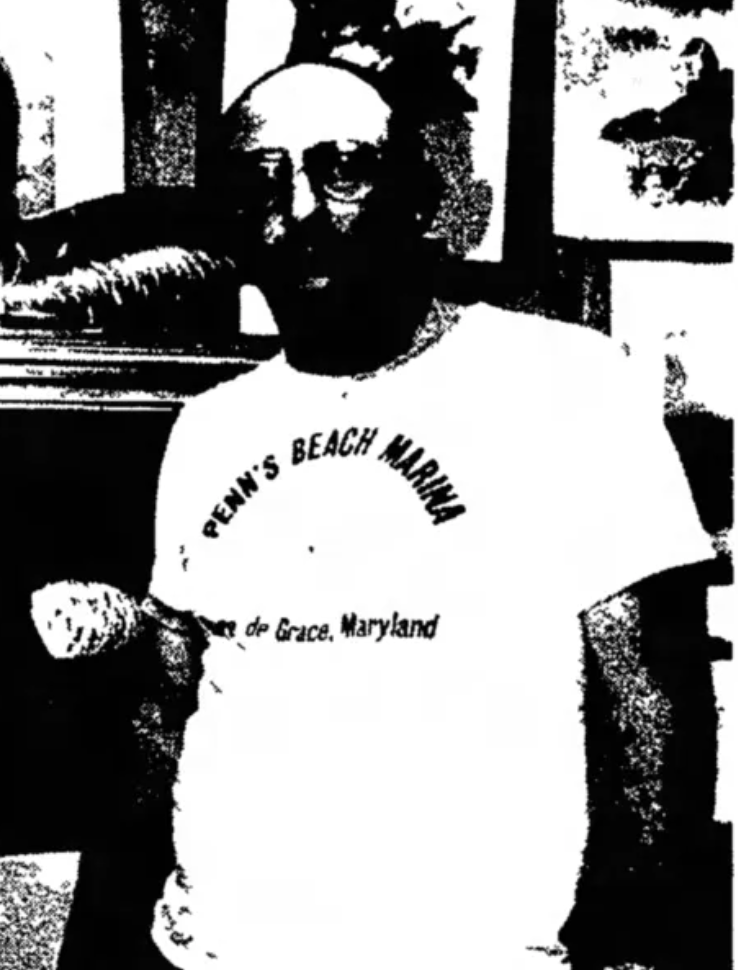
We normally stick to the Civil War-era history of Gettysburg but are making an exception in the case of Gettysburg police officer Michael W. Hofe (1947-1996). Michael Hofe is the other unrecognized hero of the William McLeod story. Thanks to the 1993 robbery of the Adams County Historical Society and Corporal Hofe’s dogged investigation, we have the McLeod-Moses-Prescott story. How did that happen?
Early Life and Background
Michael Hofe was born in Gettysburg to Edward and Arlene Spangler Hofe on October 24, 1947. Note that his mother was a Spangler. The Spangler name is immortalized throughout the battlefield today, ranging from Spangler Spring to the George Spangler Farm to the Henry Spangler Farm and other instances. He grew up in the historic town and attended high school at Gettysburg High School, which abuts the Jacob Kime Farm where Lt. Colonel William McLeod would ultimately die and be buried. A 1965 graduate of the high school, Hofe was attending when the 100th anniversary of the battle occurred and commemorations were held throughout the town and county.
Michael was also raised during the Korean and Vietnam Wars. In 1967, he joined the U.S. Army as a military policeman. In 1968, he married for the first time while a member of the 559th Military Police. He then served a tour of duty in Vietnam.
His subsequent marriage to Edith Twigg yielded a son and a daughter and brought him a stepson and stepdaughter.
In 1971, he exited the military and joined the Gettysburg Police Department where he would spend the rest of his professional life.
Time on the Gettysburg Police Force and in the Community
Michael Hofe served Gettysburg from 1971 through 1996. He eventually reached the rank of corporal, and his name appears in dozens of local newspaper articles and legal documents. He was associated with cases ranging from burglaries to domestic incidents to breaking up barroom brawls. His duties included traffic stops, accident reconstructions, and DUI investigations. He once told a local newspaper that he rarely saw or met the majority of residents who went about their days quietly but that it was the 10 percent who acted out that he got to know regularly.
Michael loved the outdoors and cultivated hobbies around them. He was a well-known carver of wood decoy ducks, once winning a blue ribbon in a competition. He and his wife operated a small company called “A Touch of Tidewater” in which they sold Michael’s and other decoys. They also raised live waterfowl on their property, and he had planned to open a water fowl hunting guide company with his hunting partner upon retirement.

The ACHS Robbery and the McLeod Story
One of Hofe’s lasting legacies comes from an unlikely source: a November 1993 burglary at the Adams County Historical Society in Gettysburg. A collection of Civil War artifacts had been stolen, and among the missing items was the personal prayer book (“Flowers of Piety”) belonging to Lt. Col. William Land McLeod of the 38th Georgia Infantry. McLeod had been mortally wounded at Gettysburg on July 1, 1863. When Hofe was assigned to investigate the burglary he realized the missing book was connected to an overlooked Confederate officer’s story. As one account recounts, “the whole story of Col. McLeod may have been lost for eternity if it not [sic] for the determined investigation of Gettysburg policeman Michael W. Hofe.” Within two months Hofe and investigators recovered all the stolen items except the prayer book. (The book had reportedly been carried by McLeod at Gettysburg and passed to a local girl, Sarah Kime, the daughter of Jacob Kime; Hofe theorized she read from it to the dying officer.)
Rather than let the episode fade, Hofe dug into McLeod’s history. He combed the Official Records and contemporary newspapers, interviewed Civil War scholars, and even contacted McLeod’s descendants in Georgia. The local Swainsboro Forest Blade ran stories about Hofe’s quest. By mid-1994 Hofe had distilled his research into a self-published booklet about McLeod’s life he named That There Be No Stain Upon My Stones. This 46–48 page illustrated pamphlet (printed by Thomas Publications of Gettysburg) told how McLeod had fallen at Gettysburg, how his body servant Moses later retrieved McLeod’s body and brought it home to Georgia, and how McLeod was finally buried on his family farm – ensuring “that there be no stain upon my stones.”
That There Be No Stain Upon My Stones
Hofe’s booklet That There Be No Stain Upon My Stones (published 1995–96) has become the definitive source on Lt. Col. McLeod’s story. It includes maps, period photographs and letters from the McLeod family, tracing the 135-year journey of McLeod’s body from Gettysburg to Georgia. Contemporary bibliographies note: “Hofe, Michael W.: That There be no Stain upon my Stones: Lieutenant Colonel William L. McLeod, 38th Georgia Regiment, 1842–1863… 46 pp, photos, maps; letters and story about the brave Georgian who died at Gettysburg and who was later taken home to Georgia by his family.” A few libraries and private collections hold this booklet today (copies occasionally appear in used bookstores or auction sites), and historians cite it when recounting McLeod’s fate. (It can also be found on Amazon.com.) Hofe’s work also shed light on other enslaved or African-American figures present at Gettysburg, cited in Civil War studies of slave veterans.
Hofe’s Sudden Passing
Michael Hofe planned to retire in 1997 and pursue his hobbies, his decoy work, and his guide business. On April 15, 1996, a local reporter did an evening ride-along with Hofe and his partner Larry Weikert (note the longstanding Gettysburg last name, Weikert . . . both Michael and Larry have deep Gettysburg roots).

Just six days later, while working his shift, Michael Hofe was struck by a fatal heart attack. He was rushed to a local hospital, which was unable to save him. He was just 48 years old and left behind his wife, his children, and his stepchildren. It was a tragedy similar, in some respects, to that which he had researched just two years before—a man cut down in the line of duty far before his time. But he left a mark that stands today: the history of people who otherwise would have been overlooked and forgotten. And for that reason, we salute Michael W. Hofe and hope that he, too, is not forgotten.
Leave a Reply