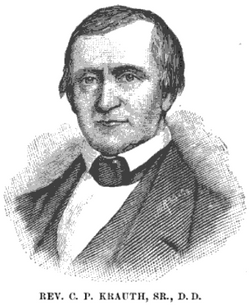
When Charles P. Krauth yielded the presidency of Pennsylvania College to Reverend Henry Louis Baugher in 1850, he had been at the helm for sixteen years. He was 53 years old, and after a lifetime of ecclesiastical service, you might assume that he was ready to retire. But Dr. Krauth did not retire—he stayed on at the college where he taught, worked in the ministry, and focused on personal research projects. His home became a hospital during the battle, and his yard became a temporary burial ground.
Early Life and Education
Charles Philip Krauth was born on May 7, 1797, in Montgomery County, Pennsylvania. He initially studied medicine but soon decided on a religious career; in 1819 the Ministerium of Pennsylvania licensed him to preach the Lutheran faith. Krauth served as pastor of Lutheran congregations in Martinsburg and Shepherdstown (then in Virginia) during the 1820s. In 1827 he was called to Philadelphia to lead a newly organized English-speaking Lutheran congregation. During this period he also helped plan the new Gettysburg Seminary: in 1826 he was selected secretary of its first Board of Directors. In 1833 Krauth was appointed Professor of Biblical and Oriental Literature at the Gettysburg Theological Seminary, and in April 1834 he was unanimously elected the first president of Pennsylvania College (later Gettysburg College).

Gettysburg College Presidency (1834–1850)
In April 1834 Krauth became President of Pennsylvania College of Gettysburg, the college’s inaugural chief administrator. He concurrently served as professor of Intellectual and Moral Science at the college and as professor of Biblical and Oriental Literature at the seminary. Early in his tenure he secured funding and oversaw construction of the college’s first main building (Pennsylvania Hall, completed 1838), which housed classrooms and dormitories. During these years Krauth worked to broaden and deepen the curriculum; at his 1834 inauguration he spoke of education as providing “the keys to open the pleasures of life” and increasing graduates’ usefulness to church and society. He resigned the presidency in late 1850 to devote himself entirely to seminary teaching. He had received an honorary Doctor of Divinity from the University of Pennsylvania in 1837.

Under Krauth’s leadership the college was governed in a deliberately “parental” style: he and his family actually lived in the dormitory building, supervising the students’ welfare. The 1882 college history praised Krauth for his “dignified bearing, suavity of manner, [and] cool temperament,” noting that his “kind but firm administration” won “respect and affectionate regard” from his students. Faculty relations were unusually harmonious during his term and Krauth was regarded as conscientious and sympathetic to students’ needs. By the time of his departure in 1850 the college’s academic standards and reputation had been greatly strengthened under his presidency.
Theological Contributions and Church Leadership
After resigning the college presidency, Krauth concentrated on teaching and scholarship within the Lutheran Church. He continued as Professor of Biblical Literature (and later Ecclesiastical History) at the Gettysburg Seminary, a post he held for the rest of his life. From 1850 to 1861 he edited the Evangelical Review, a leading General Synod Lutheran journal. In church music and liturgy he made lasting contributions: for example, he co-edited the 1828 General Synod hymnal and the 1843 Lutheran Sunday-School Hymn-Book. Krauth also published widely on Lutheran doctrine and history. His works included Early History of the Lutheran Church, The General Synod, Luther and Melanchthon, and various lectures on baptism, church polity and even the life of statesman Henry Clay.

Krauth was deeply involved in seminary governance. In 1826 he helped found the Gettysburg Seminary (serving as a trustee) and later helped shape its curriculum. He taught at the seminary through the Civil War era, reportedly delivering his last lecture on the Resurrection to the senior class just days before his death. Krauth died in Gettysburg on May 30, 1867, at age 70. Over his career he became a respected leader of the American Lutheran General Synod (the main Lutheran body of that era), though he avoided major doctrinal controversies.
Family and Descendants
Krauth married Harriet (surname unknown), and the couple had several children. Their eldest son was Charles Porterfield Krauth (1823–1883), who became one of the foremost American Lutheran theologians of the 19th century. (Charles Porterfield Krauth later led the new Philadelphia Seminary and was a key figure in the Confessional Lutheran movement.) Another son, John Morris Krauth, briefly joined the 26th Pennsylvania Emergency Militia during the Gettysburg Campaign of 1863. The Krauth family remained prominent in Lutheran education and ministry for generations.

Civil War and the Battle of Gettysburg
By 1863 Krauth was living in Gettysburg with his family and serving as seminary faculty. When the Battle of Gettysburg began on July 1, 1863, the Krauths took refuge in the cellar of their two-story brick house on Seminary Ridge (north of the seminary). Union troops soon occupied Gettysburg, and Krauth’s home was pressed into service as a field hospital for the I Corps wounded. Officers were sheltered upstairs and injured enlisted men were kept on the ground floor under army surgeons’ care. When the fighting ceased, Krauth emerged to find his house “packed full” of Federal wounded. That night the Krauth family took shelter elsewhere (likely in the seminary building) and early the next morning passed through Confederate lines with other townsfolk to Jacob Hankey’s farm on the Taneytown Road for safety. They returned home on July 6; the floors and furniture were stained with blood and a few household items had been taken (including a silver tea set, which Confederate officers reportedly returned later). (Krauth’s house, at the current address 191 Seminary Ridge Avenue, survives today as a historic site.)
Character and Legacy
Contemporaries remembered Krauth as a courteous, honorable, and earnest leader. He was described as having a “dignified bearing” and a “high sense of honor,” with warm sympathy for young people but also a “conservative judgment” that kept discipline firm. His colleagues noted his “cool temperament,” suavity of manner, and genuine dedication; under his leadership the faculty-trustee relationship remained smooth. Early in his ministry Krauth had encountered some resistance: for example, some German-speaking Lutherans in Philadelphia initially objected to his use of the English language in worship, but this opposition disappeared as his sincerity became apparent. He was generally regarded as a moderate General Synod Lutheran (unlike some more radical revivalists or strict confessionalists of the era). Krauth’s personal legacy is that of a learned pastor-scholar: he “possessed in a high degree the requisites for a successful college president” and earned the affectionate regard of generations of Gettysburg students and seminarians. His son’s prominence in Lutheran theology and the survival of his house as a Gettysburg landmark also helped keep his memory alive in church and community history.
Leave a Reply