Private Guilford Ricks was not your average enlisted Confederate. Contrary to media depictions, the Civil War was mostly a young man’s war—the average age of Confederates killed at Gettysburg was about 23. The average casualty was of modest means, owned no slaves, was unmarried, and had no kids. He was generally about 5’6″ to 5’8″, and he was generally involved in farming or agriculture.
Private Ricks, who enlisted in 1862 in the 43rd North Carolina Infantry, was a 40-year-old farmer who stood 5’9″. When he was killed on the first or second day of the battle (more on that below), he was a widower who left behind seven children, none of which had reached adulthood. At least some evidence suggests his family were prominent slaveholders and planters, though he himself was not.
Ricks was buried in the yard behind the home of Dr. Charles Krauth, where his body would remain until the 1873 when it was repatriated to Hollywood Cemetery in Virginia. His family never retrieved him nor moved him to a cemetery in North Carolina. How did Private Ricks come to be killed, then buried in the yard of Dr. Krauth?
You may recall that, in 1850, Dr. Charles Krauth handed over the presidency of Pennsylvania College (now Gettysburg College) to Reverend Henry Louis Baugher. Both men lived in houses built by the college and Lutheran congregation—Charles at 191 Seminary Ridge Avenue and Henry at 444 Harrisburg Street. The houses are about 1.5 miles apart by car, maybe 1.2 miles if you walk across campus. Thirteen years after that handover, both men would see their homes full of wounded men, and in Dr. Krauth’s case, his backyard became a temporary cemetery, particularly of men killed on Day 1 of the battle.
Guilford Ricks Before the War
Private Ricks was born in North Carolina, though to whom is unclear. Multiple genealogists have theorized that his parents were John Ricks and Margaret Elder, though no one is quite able to make the dates line up (Guilford was born between 1820 and 1824, John Ricks was born in 1803, and Margaret Elder was born in 1805). Most have speculated the connection but have been unable to document it. The connection is important, though. In 1860, Guilford was living with his children (but apparently not his wife) in Wilson County, North Carolina, while John and Margaret Ricks were living in Indiana. One of their sons, Benjamin, would later join the 9th Indiana Cavalry and be killed in December 1864 at the Battle of Nashville.

These were hardly the only Ricks family members in the area. Wilson County was formed in the mid-1850s out of a number of surrounding counties, including Nash County, where the Ricks name is prominent. The 1850 Slave Schedule shows Ricks family members—David, George, Willie, Anna, Marmaduke, D A T, and others—collectively owned more than 60 enslaved people. By 1860, the family had grown this number to more than 100.

What suggests that these might be Guilford’s family? Notice the children’s names in the 1860 Census: Guilford and his wife, Litha, named one son William and another son Willie, the latter likely a family name as shown in the 1850 Slave Schedule. Anna Ricks, daughter of George Ricks, had enslaved people in both Nash and Wilson Counties, suggesting the sprawl of the Ricks land. While records do not show that Guilford and his wife directly held slaves, it’s almost certain that they were part of the larger Ricks clan and lived on Ricks land that was largely staffed by enslaved labor.
Whether John and Margaret Ricks were Guilford’s parents, they were almost certainly relatives—yet another time in which family members took up arms against each other.
Whatever the case, life was not easy for Guilford, despite the family’s prominence. Married in 1846 to Mary Litha Nichols, Guilford and his wife had seven children between their wedding day and 1854, but by 1860, Litha had disappeared from records. She had no doubt passed away, though records do not exist to confirm when or why.
Civil War Service
In 1861 when war broke out, Guilford was almost certainly managing his farm with the support of nearby family members, the enslaved population, and probably his oldest daughter, Nancy, who would have been about 16. In February 1862, Guilford enlisted as a private in the 43rd North Carolina Infantry. Why? The first Confederate Conscription Act was still two months away, and Guilford would not have met its initial requirements anyway. His decision was purely voluntary and certainly rooted in the sectional feelings of his day. It was almost certainly rooted in the wealth in “human capital” that his family had—the average enslaved person’s market value was about $800 in 1860. In today’s money, that is about $30,000. That puts the Ricks family slave holdings at more than $3 million in today’s money. With real estate valued at $460 and a personal estate of only about $260 but with his family holding large amounts of real estate and slaves, Guilford may have been one of the more obvious family members to send to the army. Planters with high-value estates would generally be exempted from the later conscription acts, indicating where Southern society placed its value in who went to war.
The 43rd North Carolina participated in the Seven Days’ Battles, including a stretch where they were exposed to savage artillery fire at Malvern Hill. But its real baptism by fire came on Day 1 at Gettysburg. Around 3 pm, the regiment emerged into an open field along the Wills farm lane northwest of town and advanced southeast toward the unfinished railroad cut. They fought for roughly 3 hours and sustained at least 140 casualties out of 583 men: a 24% casualty rate that ranks relatively high among units engaged that day.
Guilford Ricks was one of those casualties. Records indicate he was killed July 2, but the unit was held in reserve that day before being deployed to Culp’s Hill on Day 3. So Guilford was either mortally wounded on July 1, then died on the second while around the Krauth house, or he was killed on July 1, then buried at the Krauth house by burial crews.
The Ricks Family after the War
Many of those who would die from wounds at Gettysburg were either lost entirely or suffered for months before dying in hospitals either in the North or South. Until the Buseys published their definitive Confederate Casualties at Gettysburg, most of these were almost impossible to trace. But Guilford was not one of the lost who simply disappeared. Members of his regiment reported his death, and on July 30, local North Carolina newspapers listed him as one of the killed.

The Ricks children were now orphaned. Who raised them is unclear, though they didn’t lack family in the area. The loss was beyond emotionally devastating. When slavery was finally dismantled, a huge amount of family wealth disappeared. The economy was in shambles, and the tensions of Reconstruction were still to follow. Most of the children appear to have lived to adulthood.

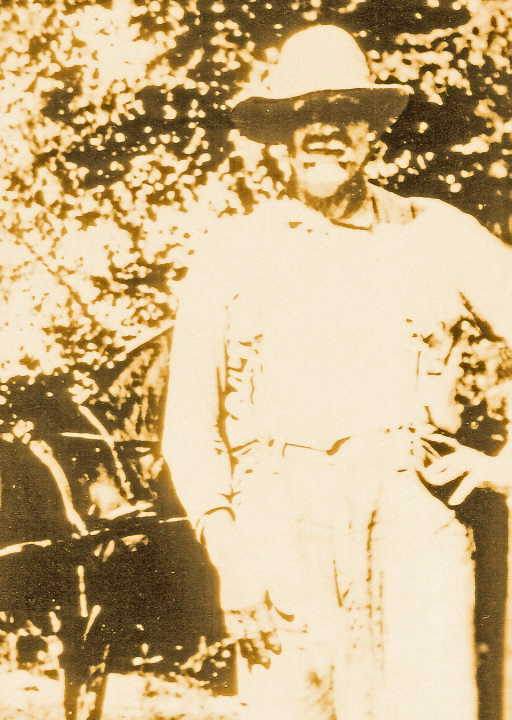
Nancy, William, John, Sarah, and Louisa all married and had children of their own. An old photo shows William in standard farm attire of the day, perhaps the strain of the years and the sun on his face. A similar photo of Louisa is a mask behind which an untold number of challenges lay.

It’s unclear whether the children knew the location of their father’s remains. In 1873, when southern memorial associations were paying to have bodies reinterred on Southern soil, Guilford’s body was removed from the land behind Dr. Krauth’s house and shipped to Hollywood Cemetery where it remains today.
Leave a Reply