The person easiest to track in this story is William Weikert, son of John George Weikert. Mercifully, nearby Weikerts in the same generation did not have a son named William Henry.
When talking about men named George Weikert in Civil War Gettysburg, we have to get precise. It doesn’t help to go to middle names: three men in the 1860s were named George Washington Weikert. The oldest of the three had a prominent farm that stands on the battlefield today. That George had a son named George who had to testify against his brother John Thomas Weikert.
Living nearby was John George Weikert who was in the same generation as the elder George W. Weikert. John George owned a farm on the Taneytown Road, and he also had a son named George Washington Weikert who was eight years younger than George W. Weikert Jr. Got it? Younger George was a cousin of George Jr. And as it would happen, much as George Jr. and John Thomas had legal issues with each other, George son of John George had issues with his brother, William Henry.
Early Life and Family of William Henry Weikert
William Henry Weikert was born March 8, 1839 in Straban Township, Adams County, Pennsylvania. He was the son of John George Weikert (1803–1873) and Eve Catherine Brinkerhoff (1815–1894) His paternal grandparents, John Weikert (1781–1861) and Elizabeth Bishop (1781–1826), were early Adams County residents. William grew up in a large family: he was one of eight children, with siblings including an older sister Clara E. (1837–1864) and younger brothers John Baltzer (1842–1921) and George Washington Weikert (1844–1927). The Weikert family lived on their farm in Adams County (listed in Straban in the 1850 census), and they were of Pennsylvania Dutch (German) heritage, likely Lutheran by faith (like many local families).
In 1867, at age 27, William married Lucinda Lady (1842–1918). The couple settled in Adams County and raised a large family. They had seven children (though only six seem to have reached adulthood): Charles J. Weikert (born 1868), Clara Jane Weikert (born 1871, later married surname Topper), Henry J. Weikert (born 1872), Harriet E. Weikert (born 1874), Sallie C. Weikert (born 1878, later Guise), John Robert Weikert (born c.1880), and Dillie E. Weikert (born 1884), among others. (Some records appear to list Clara and Sallie twice under married and maiden names.) William’s wife Lucinda and several children survived him. The family was rooted in Adams County, with many members later buried in Gettysburg’s Evergreen Cemetery.
Civil War Service (1861–1865)
Like several of his brothers, William Henry Weikert served in the Union Army during the American Civil War. A family history notes that he “saw service in the Civil War,” although details of his enlistment are confusing. His Find-a-Grave entry says he served first in the 21st Pennsylvania Cavalry, which trotted around newly formed West Virginia for a bit before mustering out. It then says that he joined the 87th Pennsylvania, the unit most commonly associated with Gettysburg men. There he allegedly served three months before the war’s end.
The trouble is that civilwardata.com (subscription product) gives different birth and death dates for the William Weikert in the 21st Pennsylvania Cavalry. So, it’s hard to say who’s right. Either way, though, he would not have seen much action, unlike some relatives, like his cousin John T. Weikert who was wounded at Mine Run – and William’s service record does not stand out in official battle reports.
Despite the lack of detailed unit records in published sources, post-war pension indexes confirm William H. Weikert as a Union veteran. His name appears in the General Index of Civil War pension files (indicating either he or his widow later applied for a pension). This suggests he was honorably discharged and eligible for veteran benefits. In sum, William’s military service was real, though relatively quiet: he answered the call to defend the Union, served his term, and returned home to Adams County once the war ended in 1865.
Post-War Life in Adams County
After the Civil War, William Henry Weikert returned to civilian life in Adams County. He spent the remainder of his life as a farmer in his home community. Census records show him residing in Adams County townships (Straban and possibly nearby areas) in the decades after the war, working the land and raising his growing family. In the 1880 U.S. Census, for example, William was listed as a farmer with wife Lucinda and their children on the home farm (several of their young children were born throughout the 1870s). Farming was the family livelihood – a common occupation in this rural region of Pennsylvania. There is evidence that William owned or inherited land in Adams County (his father John George Weikert had a farm in Straban Township).

In community affairs, William kept a low profile. William did not seek public office. This may be due in part to personal controversies (discussed below) that made him less visible in civic life. However, he was certainly known locally – the Weikerts were a long-established family in the Gettysburg area, with several branches (William’s cousins included those who owned the famous Jacob Weikert farm used as a field hospital during the battle of Gettysburg). William likely attended local Lutheran or Reformed church services with his family and participated in veterans’ gatherings to the extent his reputation allowed.
In his later years, William witnessed the turn of the century and the growth of Gettysburg as a national memorial town. He lived to see the 50th anniversary of the Battle of Gettysburg in 1913. On November 13, 1915, William Henry Weikert died at age 76, still residing in Adams County. He was interred in Evergreen Cemetery in Gettysburg, the same resting place as many local Civil War veterans and family members. His widow Lucinda survived him by three years (dying in 1918). At the time of his death, William was remembered in the community simply as an “aged veteran and farmer.” While he did not leave behind extensive public records, he was survived by a large family and a story deeply entwined with Adams County history.
Legal Conflicts with His Brother (1870s–1880s)
Despite an otherwise ordinary post-war life, William Henry Weikert was at the center of a scandalous family feud in the late 1870s. A bitter rift developed between William and his younger brother, George Washington Weikert, resulting in legal battles that became local gossip. The trouble began in 1877, when George W. Weikert formally accused William of adultery – specifically, an affair with George’s wife, Rebecca J. Weikert. On December 1, 1877, a criminal charge of adultery was lodged in Adams County against William H. Weikert, “for adultery with Rebecca J. Weikert, wife of George W. Weikert.” This case would have been handled in the Adams County Court of Quarter Sessions as adultery was then a punishable offense. Indeed, about a year later, the case was slated for court, but George didn’t show up to press the charge.

It was an explosive allegation: essentially, George accused his own brother of carrying on illicit relations with his (George’s) spouse.
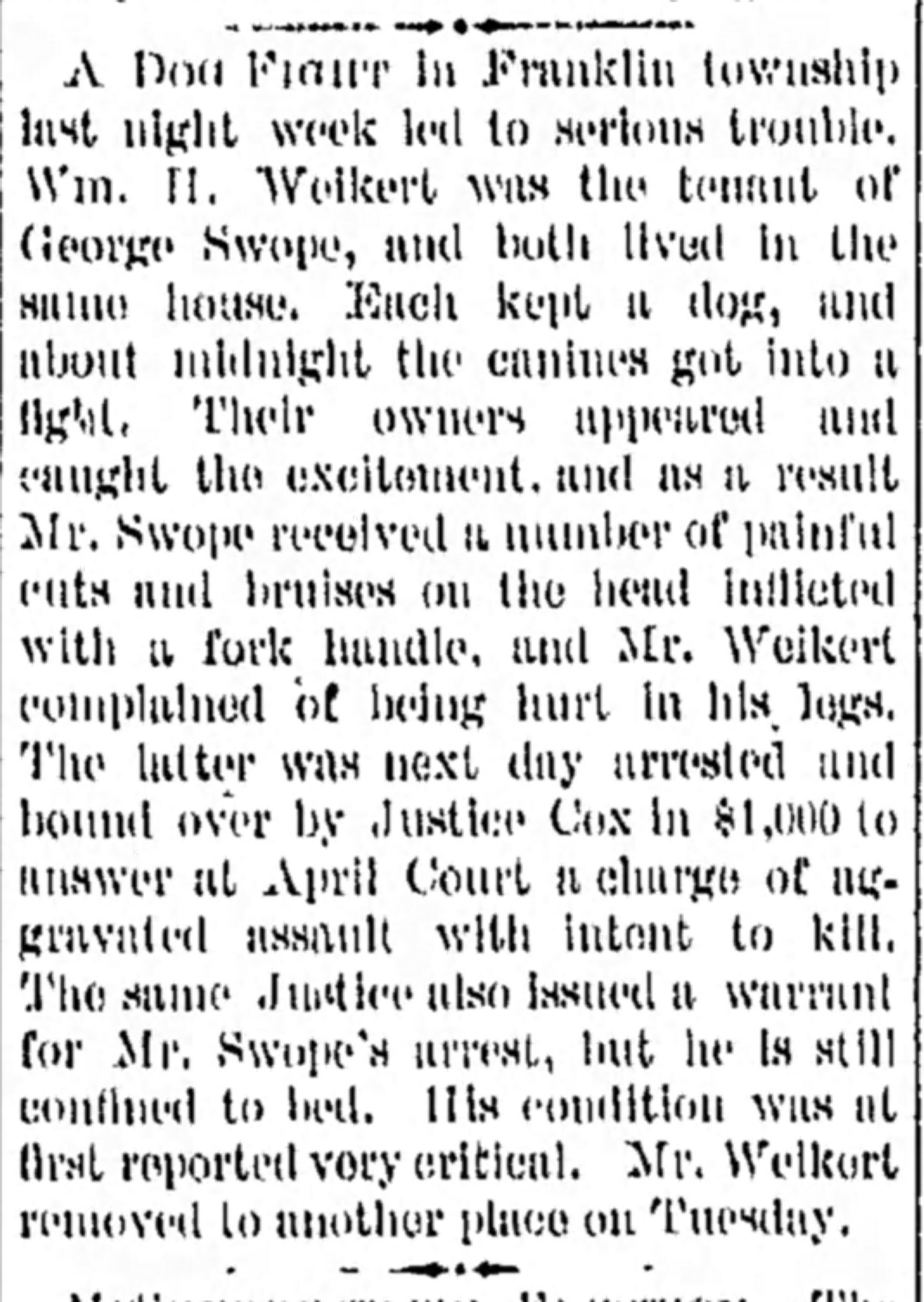
William’s legal and family issues did not end there. In 1883 and 1884, William was a tenant of George Swope who descended from the powerful banking family in Gettysburg. The Swopes and Weikerts had at least one marriage among the families and shared some relationships. Both George and William had dogs, and according to the Gettysburg Compiler, their dogs got in a fight. Both men intervened to break up the fight, George was injured, and shortly thereafter, George accused William of assault with intent to murder. You read that right—the dogfight turned into an attempted murder charge.

The newspapers don’t seem to have recorded the resolution, though no record suggests that William served any time. It seems likely that the issue faded in the legal system just as the adultery charge had.
Despite these troubles, the Weikert brothers lived out their days in Adams County. George W. Weikert remained a farmer and lived until 1927, and William H. Weikert, as noted, died in 1915.
Leave a Reply