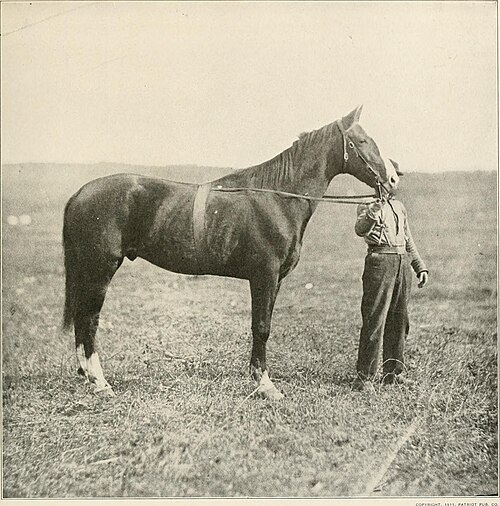
The horses of Gettysburg are their own tragedy. When the armies untangled from each other at Gettysburg on July 4, they left not only more than 6000 dead men, they also left between 3000 and 5000 dead animals. Horses and mules were integral to both armies, though their roles are generally only lightly touched upon in most popular histories. The slaughter of thousands of animals at Gettysburg in the thick of summer greatly worsened the sanitary plight of the town.
The Army’s Backbone: Horses and Mules in War
Horses and mules were the backbone of Civil War armies, performing roles now filled by vehicles. At Gettysburg, they pulled cannons, supply wagons, and ambulances, and carried cavalrymen, officers, and couriers into action. Historian Gregory Coco estimates the Union Army of the Potomac brought over 43,000 horses and 21,000 mules to the Gettysburg campaign. The Confederate Army likewise relied on tens of thousands of animals. In total, roughly 72,000 horses were present at Gettysburg between both sides. Keeping these animals alive was a colossal logistical effort: each horse required about 10 gallons of water and 26 pounds of feed per day, amounting to over 700,000 gallons of water and nearly 1.9 million pounds of fodder daily for all the horses on the field. Such figures illustrate how critical equines were to army operations – and how their care and feeding could strain supply lines.
Life was hard for these war animals. Endless marching and exposure left them vulnerable to exhaustion, disease, and malnutrition even before battle. Once combat began, horses often became prime targets. As one account notes, “shooting and killing [horses] first during a battle” could cripple the enemy – dismounted cavalrymen became easy prey, and artillery without horses couldn’t maneuver. Both armies understood this, and sharpshooters and gunners did not hesitate to cut down horses to gain an advantage. Cavalry commander Gen. George A. Custer reputedly had 11 horses shot from under him during the war (including two in one day at Gettysburg), showing how intense the attrition of mounts could be. Officers typically kept multiple mounts and rotated them to avoid exhaustion, but in the fury of battle even favorite horses could fall. These animals toiled alongside the soldiers, and many Union and Confederate men felt great attachment and responsibility toward their four-legged comrades.
Staggering Casualties Among the War Animals
The Battle of Gettysburg’s carnage extended to animals on an almost unimaginable scale. Contemporary observers described fields littered with dead and dying horses after the fighting. Estimates of equine deaths during the battle range from as low as 1500 to as high as 5,000 animals killed in three days. In fact, one postwar analysis notes that at Gettysburg alone “3,000 to 5,000 horses were killed.” For perspective, that is roughly one dead horse for every two human soldiers killed at Gettysburg. A Union cavalryman summed up the aftermath grimly: “dead horses lay around… so thickly that we had to search for a way through them.” The sight and smell of so many animal carcasses made a deep impression on survivors.

Artillery units in particular saw horrific losses of horses. Each artillery battery required six or more horses per gun, and Confederate fire often tore into these teams. During the fierce fighting on July 2 at Trostle Farm, Capt. John Bigelow’s 9th Massachusetts Battery lost 50 horses in a desperate rearguard action. Photographs taken after the battle shows the Trostle farmyard strewn with dead artillery horses, confirming that 16 carcasses lay just in front of the farmhouse and about 100 total across the farm’s fields. On the final day, July 3, the massive Confederate bombardment before Pickett’s Charge wreaked havoc on Union batteries at the front. Lt. Alonzo Cushing’s Battery A, 4th U.S. Artillery, which defended the Bloody Angle, suffered an almost complete loss of its equine team – “out of 90 horses 83 were killed” in that unit. An eyewitness described the scene during the cannonade: “the shrieking shells… the splash of bursting shrapnel, [and] the fierce neighing of the wounded and dying artillery horses” combined into a “terribly grand and sublime” tableau. The piercing screams and neighs of injured horses often filled the air, adding an agonizing soundtrack to the battlefield. Soldiers later recalled such sounds as among the most haunting memories of Gettysburg.
Cavalry units likewise saw their mounts cut down in droves. In cavalry clashes and charges on the flanks, horsemen on both sides watched loyal mounts collapse beneath them. As mentioned, Custer lost two horses during the fighting. In the ill-fated Farnsworth’s Charge on July 3, Union troopers galloping against Confederate positions met with withering fire; many riders were unhorsed or killed alongside their mounts (Gen. Elon Farnsworth himself was shot dead in the saddle). The toll was not limited to unnamed animals. Even high-ranking officers’ famous horses were at risk. Old Baldy, the beloved horse of Union General George G. Meade, was wounded at Gettysburg – a bullet grazed his stomach during combat, and for the first time the veteran warhorse refused to advance further. (Old Baldy survived the battle and was eventually retired, carrying scars from his many wounds.) On the Confederate side, General Robert E. Lee’s gray stallion Traveller carried him through the Gettysburg campaign and survived unscathed. Lee rode Traveller out amid the defeated Army of Northern Virginia on July 4, consoling his troops; man and horse would remain together for the rest of Lee’s life. But for every renowned horse that survived, countless other less famous horses and mules met a brutal end on the battlefield. The sheer scale of equine death at Gettysburg stunned those who witnessed it. One nurse wandering the field after the guns fell silent wrote of animal corpses “steaming in the sun” as they decomposed in the July heat. By one calculation, the combined weight of dead horses and men at Gettysburg approached six million pounds of flesh rotting under the summer sky – a hideous feast for vultures and flies.

Grisly Aftermath: Dealing with the Dead
When the battle was over, the victorious Union Army and local civilians faced the monumental task of disposing of thousands of dead horses and mules. Priorities dictated that human bodies were attended to first for burial. Animal carcasses, by contrast, were left to lie where they fell for days, swelling and decomposing. Many Gettysburg residents and soldiers recalled the overpowering stench that soon hung over the battlefield. “A sickening, overpowering, awful stench announced the presence of the dead”, one account noted bluntly. Another witness described how the odor of death would hit travelers “long before they get there” – the smell of Gettysburg’s carnage carried for miles on the summer wind.
To prevent pestilence, authorities eventually organized details to clear the animal remains. Burying such large animals was difficult work – an average horse weighs half a ton, and stiff legs would be sticking out of shallow pits. On some battlefields, specialized teams chopped off horses’ legs to make dragging the bodies into trenches more manageable. At Gettysburg, however, the number of carcasses was overwhelming and time was short. The decision was made to burn most of the horse corpses rather than bury them. Huge pyres of dead horses and mules were soaked in oil or kerosene and set ablaze. This grisly work fell to Union provost guards, local volunteers, and even some captured Confederate prisoners roped into the task. Eyewitnesses speak of piles of carcasses burning day and night. “The odor from the burning horse flesh… smell[ed] like an escape from a hateful charnel house,” one Gettysburg resident recalled, comparing it to the stench of an open crypt. Flames and smoke filled the humid air, and at night an eerie glow emanated from the funeral pyres of the army’s beasts.

Lydia Leister’s farm served as Gen. Meade’s headquarters, and when she returned on July 4 she found 15–17 dead horses scattered across her small yard. A Confederate shell had exploded among the staff’s tethered mounts during the battle, killing them all. With no way to dispose of so many 1,000-pound bodies, the widow Leister had to let them rot where they lay on her property. She later testified that she waited two years for the horse corpses to decompose; only then could she scrape up and sell the remaining bones – about 750 pounds of bone in total – for scrap value. At roughly half a cent per pound, those bones earned her a mere $3.75, one of the few forms of compensation she ever received for the devastation of her farm. The toll on her property was immense: the carcasses contaminated her well and spring, destroyed fences and a peach tree (when some horses were burned there), and her fields and orchard were trampled and ruined. The Leister farm was just one of many Gettysburg homesteads left scarred by heaps of animal remains. At the Trostle farm, Catherine Trostle similarly returned to find dozens of dead horses strewn about; she counted 16 in her yard and over 100 on her land, and filed damage claims for the cleanup.
Despite extensive burning, not all carcasses could be fully destroyed. Some horse remains lay in spots too close to buildings or valuable trees to be set on fire. Those were left to decay naturally, with quicklime (calcium oxide) often spread to hasten decomposition and mask the smell. Months later, travelers still reported whiffs of death around Gettysburg, and white streaks of chloride of lime marked places where attempts had been made to sanitize the ground. The ground itself absorbed the legacy – for years, farmers plowing fields near Gettysburg would strike old bones, unearthing the grim remains of fallen soldiers and beasts.
Caring for the Wounded and the War’s Legacy
Not all the horses at Gettysburg were killed outright; many were wounded and left in agony after the battle. Soldiers attempted to show mercy where they could. Cavalrymen and artillerymen often had to shoot badly injured horses on the field to end their suffering. One Union artilleryman recalled turning his revolver on the loyal creatures that had hauled his cannon, calling it a “mercy shot” even as he wept doing it. Other injured animals that had hope of recovery were rounded up in the days following the battle. Makeshift veterinary hospitals were set up in town using corralled yards or any available enclosure. “Horse doctors” (veterinary surgeons and farriers) and volunteers like blacksmith Private Hezekiah Weeks labored to clean wounds, set broken limbs, and feed the traumatized horses and mules that could be saved. These efforts went on for weeks. As time passed, Army quartermasters evaluated the recuperating animals: which could return to duty, which might be sold for farm work, and which were too maimed to survive. Sadly, several hundred “unrecoverable” horses and mules had to be euthanized even after weeks of care. The Army herded these spent animals to a secluded area by Rock Creek and shot them, leaving heaps of skeletons that reportedly remained visible for decades as a stark reminder of the cost of war.
Many other horses did recover. By mid-August 1863, the Army advertised an auction of 350 “condemned” U.S. horses and mules at Gettysburg. “Condemned” simply meant they were no longer fit for military service. Local farmers, many of whom had lost their own draft animals to Confederate foraging or battlefield chaos, eagerly bought these war-weary horses to rebuild their livelihoods. Thus, a number of Gettysburg’s four-legged veterans lived on in civilian hands – plowing fields and hauling wagons on the very ground where they once charged and bled. One can imagine a farmer’s plow horse stopping suddenly as the plowshare hit something hard beneath the soil, only for the farmer to dig up a piece of bone – perhaps from an unknown soldier, or perhaps from an unknown horse. The intermingled fates of men and animals were literally embedded in the earth.
In the broader picture, the plight of Gettysburg’s horses and mules shines a light on the immense human toll and logistical strain of the Civil War. The loss of thousands of equines in a single battle hampered both armies – artillery batteries were immobilized, cavalry units dismounted, supply wagons stranded. The Union Army, victorious but exhausted, had to delay pursuit of Lee’s retreat partly to regroup and secure fresh horses. Confederate General Lee, atop Traveller, lamented the loss of so many of his invaluable animals, which compounded his army’s inability to continue offensive operations. Beyond the strategic impact, there was a profound emotional impact on the soldiers and witnesses. These animals had been faithful companions in war, and their suffering was keenly felt. Veterans on both sides wrote of the pitiful scenes of wounded horses on the field, the smell of burning flesh, and the awful duty of killing gravely injured beasts. Such memories contributed to the lasting trauma of Gettysburg. As one veteran later reflected, “It’s an ugly part of war history that most people don’t even want to think about,” yet it remained seared in his mind.
Today, the sacrifice of Gettysburg’s “silent partners” is remembered in subtle ways. Many Gettysburg battlefield monuments feature generals astride their mounts, a testament to the bond between soldier and horse. (In some cases, the horse’s name is even inscribed alongside the rider’s.) The famous war-horses like Old Baldy and Traveller survived to live out their days – Old Baldy marched in a post-war parade and had his head mounted for posterity, and Traveller was eventually laid to rest near Lee’s tomb. But thousands of less-famed horses and mules gave their lives at Gettysburg and across the Civil War. Historian Bruce Catton observed that war is cruelest on the most innocent; at Gettysburg, “we know it wasn’t the horse” who won. The story of Gettysburg’s horses and mules resonates because it humanizes the cost of war – reminding us that the trauma of battle spared no living thing, human or animal. In remembering these loyal, voiceless partners, we gain a fuller understanding of the battle’s reality and a deeper appreciation of the innumerable sacrifices that war entails.
Leave a Reply