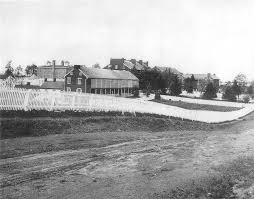
The name Ephraim comes from the Bible and means “fruitful” or “doubly fruitful.” By all appearances, Ephraim Albert appeared to fit the definition. He was a farmer who was the son of a farmer—the youngest of at least three, possibly more, kids in fact. And Ephraim was similarly fruitful. In the 1870 Census, he’s shown with his wife and seven kids.

Everything up to that point seemed pretty normal. But Ephraim had some unfortunate commonalities with Abraham Trostle and Captain James Wade.
Early Life and Family
Ephraim C. Albert was born in Pennsylvania August 1, 1834. He was the son of Henry and Mary Albert of Adams County, PA. In the 1850 Census, he is the only child left at home. His father’s estate was valued at $1100—not wealthy but not poor.

By the mid-19th century, Ephraim had settled in Adams County and lived for about two decades in Reading Township, Adams County. He married Elizabeth “Eliza” Albert, née (maiden name possibly Eurich or Hoffman), who was born circa 1830. The couple resided in the village of Hampton in Reading Township, a farming community. Like his father, Ephraim was a farmer, and his father’s will ensured that he received a cut of his land as well as an inheritance of at least $500.

During the war, Ephraim registered for the draft, but he has no service records, suggesting he was never called up.

Ephraim and Elizabeth Albert raised at least seven children. Their known children include Mary Jane Albert (born 1857), who later married into the Lerew family, and Jacob Harvey Albert (born 1862). The Census indicate the Alberts may have had additional children, such as Sarah Catherine, William Curtis, and John H. Albert, among others. Mary Jane and Jacob were in their late teens or early twenties by 1880. The Albert family was thus well-established in Adams County by the late 1870s, with Ephraim appearing as head of household in local records (for example, the 1870 U.S. Census of Reading Township) and participating in ordinary community life.
Mental Illness and Murder
The records only allude to it, but a mention in the newspapers after the crime make it clear—in the 1870s, Ephraim’s mental health suffered tremendously. A local court ruled that Ephraim was non compos mentis or “not of sound mind.” This ruling would have been made in the Orphans’ Court in Adams County and might well have led to a stay in the Adams County Alms House. It also suggests that his family, at a minimum, and possibly his neighbors, as well, brought him to the court, seeking relief.
Whatever help was supplied proved temporary. In 1880, the Census shows the family still mostly in tact . . . just before tragedy struck.

On June 14, 1880, Ephraim and his wife Eliza attended a band festival in a neighboring town. As they headed home after, they encountered a fence. Ephraim lowered a couple of boards, and Eliza crossed first. Ephraim then crossed and replaced the boards. According to him, when he looked up, he saw “something ugly.” The York Daily said he and his wife had an exchange of words in which she tried to assure him, but he became more convinced that a dog was near. He pulled out his pistol and fired. The bullet hit Eliza, twenty feet ahead, in the right groin, passed through her bowels, and lodged near her left hip. She lingered for several days in agony before passing away.

The newspaper originally reported that an inquest ruled the shooting accidental. But local law enforcement didn’t agree. A few days later, they arrested Ephraim, allegedly at his wife’s gravesite weeping.

By that point, the “something ugly” Ephraim had aimed at had morphed into a dog. Of course, the newspaper reported unironically and with a straight face that Ephraim “shot his wife in mistake for a dog.” According to Adams County records, Ephraim was indicted. A few days later, Ephraim posted bail as the newspaper again reported that he had mistaken his wife for a dog.

From there, the legal trail related to Ephraim goes cold for more than a decade. Was he tried? It is unclear. His last known residence before death was the Adams County Alms House. It’s possible that he was committed there with or without trial, depending on whether he was deemed competent to stand trial. It’s conceivable he spent the rest of his life there or possible that he lived there only at the end.
Ephraim Albert Dies . . . Twice
Whatever the case, he was functionally dead to the family. In 1892, letters “testamentary on the estate of Ephraim Albert late of Carroll Township, deceased” were presented to his sons William, Albert, and Jacob. In addition, a Widows’ Appraisal of the estate was ordered.


What’s odd is that Ephraim was not actually dead, while his widow, who was entitled to a minimum of one-third of his estate, actually was dead. So what happened? In 1892, while Ephraim was living in diminished condition (possibly already in the Almshouse), his sons likely sought to settle or secure property in Carroll Township. That is, they petitioned to have the estate treated as though Ephraim had already died. Probate procedure used the formula “late of… deceased,” even though he was technically still alive. The “widow’s appraisement” announcement was likely a standard process in valuation, though Eliza was no longer alive. The widow’s portion, in her absence, would then be distributed separately from the estate.
However the estate was finally settled, Ephraim did finally die in 1898. He was buried at the Adams County Almshouse Cemetery—separate from his parents and wife who were buried in Hampton Union Cemetery. In fact, it’s possible his children never tended to his remains and left him solely to the county, left alone to be dealt with impersonally.
Leave a Reply