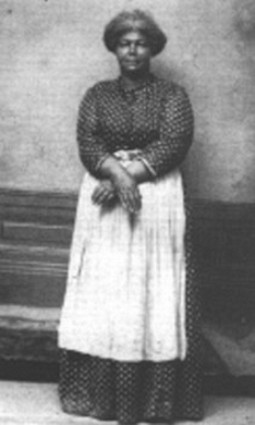
You may recall from the story of Mag Palm that, at her lowest point, she attempted to drown her son and commit suicide. That son was Alfred S. Palm, named after his father, and the local papers reported the incident as follows.

You may also recall that Mag suffered through a kidnapping attempt that bore some resemblance to the miserable experience of Catherine Payne a decade earlier. We also saw that the older Alfred Palm and his wife Mag had a fraught and sometimes violent relationship that resulted in criminal charges at times.
So what became of Alfred S. Palm?
Early Life and Family Background
Alfred S. Palm was born in Gettysburg in May 1870 to Margaret “Mag” Palm and Alfred Palm Sr.. His mother Mag Palm was a formerly enslaved African American woman known for her remarkable resilience: in 1858 she famously fought off an attempted kidnapping by slave catchers, even biting off one attacker’s thumb, and successfully brought the culprits to court. Mag’s courage made her a local legend, but the trauma of that event – and the constant threat of kidnapping faced by free Black families near the Mason-Dixon line – left lasting scars.
Alfred’s father, Alfred Palm Sr., struggled with poverty and was frequently in trouble with the law. In the 1850s he served a sentence in Eastern State Penitentiary for larceny (described in prison records as an illiterate barber with a scar and an “occasionally intemperate” disposition). He was later convicted of assault and battery in 1866 – a crime that contemporary records indicate was an attack on Mag Palm. More charges for assault followed in 1874. These hardships meant Alfred S. Palm grew up amid instability, violence, and hardship. In 1879, Mag Palm suffered a severe mental health crisis (reportedly a near-tragic suicide attempt) under the strain of these circumstances. Young Alfred survived this tumultuous childhood, but the cycle of violence and instability in the Palm family would continue into his own adult life.
Legal Troubles and Criminal Record: A Timeline
Alfred S. Palm’s life was marked by numerous run-ins with the law, mirroring some of his father’s challenges.
In 1910, Alfred and his wife Anne infamously hit the papers.

In this incident, Alfred allegedly visited his wife’s place of work, insisted she leave early, then assaulted her on the way home. This resulted in his arrest. In turn, his wife visited an attorney, and as the conversation progressed, she grew frustrated, hurled a paper weight at William Hersh, Esq., and was subsequently arrested.
On October 3, Alfred was released on bail. On October 10, charges were dropped, and Annie Palm was committed to the Adams County Almshouse for problems with her sanity.

Viewed through today’s lenses, it’s hard to tell what happened here. History has taught us to give more credence to the stories of women being abused, while also showing us that women who filed charges were frequently treated as irrational, insane, or out of their place. Whatever the case, the Palm household had its challenges.
In 1918, Annie passed away in her mid-fifties.

Just two years later, Alfred would wind up in prison again. In what would seem juvenile and comical by that era’s standards, Alfred was charged with stealing chickens.

Alfred’s attorney, George Benner, argued that his client was never known to steal and had been an industrious worker. But the court noted that he had been accused in similar crimes and handed down a three-month sentence.

Marriage, Family, and Personal Life
Despite his troubles, Alfred S. Palm tried to build a family life in Gettysburg. He married Annie R. Palm (née Crouse) in the 1890s. Annie, about five years Alfred’s senior (born 1865), was by all accounts a resilient woman in her own right. The pair had several children (at least four) over the years:
- Louise Palm Stanton – Born around the late 1890s, Louise was the elder daughter of Alfred and Annie. She married Freeman Levi Stanton in 1917. The couple lived in Gettysburg and had two daughters, Dorothy (b. 1918) and Catherine (b. 1921). Tragically, Freeman Stanton died in 1924 at a young age, making Louise a widow by her mid-20s. Louise remained in Gettysburg after her husband’s death. She stayed deeply involved in the local Black community – in fact, she became a Sunday School teacher at St. Paul’s AME Church, the historic African American church in town. Betty Dorsey Myers, a local historian, later recalled that “Mag Palm’s granddaughter, Louise Palm Stanton… once was her Sunday School teacher.” Louise Palm Stanton died in Gettysburg and was buried in Lincoln Cemetery, the Black cemetery where her famous grandmother Mag Palm and her parents are also interred.
- Gertrude Palm (Mrs. James D. Moore) – Another of Alfred’s daughters, Gertrude Palm married James D. Moore of Harrisburg, PA in the 1920s. In contemporary accounts she is referred to only as “Mrs. James Moore of Harrisburg,” but family records identify her first name as Gertrude. She and her husband settled in Harrisburg. Gertrude’s ties to Gettysburg’s community remained strong; like her sister, she was raised in St. Paul’s AME Church in Gettysburg, though after marriage she lived in Harrisburg. (Gertrude’s middle initial was “D.” – possibly standing for a middle name or her married surname Moore – and one record lists her as a member of St. Paul’s AME Church in Gettysburg as well.) In October 1928, Gertrude was involved in the fateful car trip that took her father’s life (see below), but she survived the accident with minor injuries. It is not clear if Gertrude returned to Gettysburg later in life; she is likely the “Gertrude D. Palm” buried in Lincoln Cemetery records, but further research would be needed to confirm her later activities.
- Harry Palm – Alfred’s only son, Harry Palm, moved to Baltimore, Maryland as a young adult. Little is documented about Harry’s early life in Gettysburg, including whether he was the same son injured in the 1910 domestic incident (the newspaper did not name the boy). By the 1920s, Harry was living in Baltimore and is not recorded as having been involved in his father’s legal troubles. He was alive at the time of Alfred’s death and was listed among the survivors in Alfred’s obituary as “Harry Palm, of Baltimore.” Beyond that mention, Harry’s role in the Gettysburg community appears minimal – he likely sought opportunities in the larger city.
- (One additional child) – Some family sources indicate Alfred and Annie Palm had a fourth child, who perhaps died young or left little trace in surviving records. This child is not named in Alfred’s 1928 obituary, suggesting he or she did not survive to adulthood or was no longer in contact. One possibility is that Alfred and Annie had a daughter who died in childhood (this would not be unusual in that era). Unfortunately, current records do not provide further details on this fourth child.
Annie R. Palm, Alfred’s wife, endured a difficult marriage marked by Alfred’s drinking and violence. Nonetheless, she appears to have been a stabilizing presence for as long as she lived. Annie died on September 27, 1918, at about age 53. (Her headstone mistakenly gives a date of Sept. 5, 1918, but her death certificate and obituary confirm the September 27 date.) Annie’s obituary in the Gettysburg Times (Sept 28, 1918) likely listed her survivors and perhaps noted her involvement in the A.M.E. Church, though the full text is not readily available. With Annie’s death coming in the midst of the 1918 influenza pandemic, it is possible she succumbed to illness, but again, documentation is sparse. After Annie’s passing, Alfred S. Palm did not remarry. The loss of his wife left Alfred essentially alone; his daughters were entering adulthood and marrying, and he no longer had a stable home life. This personal decline in the 1920s is evident in his living situation and final years.
Later Years, Employment, and Community Engagement
In his final years, Alfred S. Palm lived a somewhat transient or communal life. He made his home in the rooms of the Colored Elks lodge on West High Street in Gettysburg. The African American Elks (a fraternal organization officially known as the Improved Benevolent and Protective Order of Elks of the World) had a lodge in Gettysburg that served as a social hub and boardinghouse for members. Alfred’s residence there suggests he remained connected to the Black fraternal and social community despite his personal troubles. It may also indicate that he had given up or lost the family home after his wife’s death, choosing to live among fellow lodge members.
For work, Alfred continued the kind of labor his family had long performed. Census records earlier in life listed him as a laborer, and by the late 1920s he was employed by a local construction contractor. In fact, at the time of his death Alfred worked as a laborer for Charles Lady, a Gettysburg building contractor. This job may have been one of the few steady employments in his life, as much of his earlier record suggests economic instability. There is no evidence Alfred achieved any higher trade (unlike his father who had been a brick-maker and barber in earlier years). Instead, Alfred likely picked up day labor work where he could. His employer Charles Lady was a notable local contractor, so working for Lady might indicate Alfred had a regular paycheck and some standing as a reliable worker in his final year or two.
Alfred S. Palm’s religious and community involvement were probably centered on Gettysburg’s Black institutions. He was almost certainly raised in St. Paul’s African Methodist Episcopal (AME) Church, the same church where his mother Mag had been part of the community and where his children later were members. While Alfred’s own name is not prominently noted in surviving church records, his family’s presence (e.g. his wife Annie’s funeral, and his daughters’ participation) points to the Palm family being part of St. Paul’s congregation. This church, along with the Elks lodge, the Sons of Goodwill cemetery society, and other Black organizations, formed the fabric of Black civic life in Gettysburg. Given Alfred’s checkered reputation, he may not have held any leadership roles, but his mere association through family ties meant he was part of that community network. His daughter Louise’s active role as a Sunday school teacher in later years shows that the next generation of Palms carried forward a positive engagement with the community, even if Alfred himself struggled to do so.
In summary, by the mid-1920s Alfred S. Palm was a widower, living in a fraternal lodge, and making ends meet as a hired laborer. He was still close to his grown children – evidence suggests he visited them and attended social events together – but his personal life had been marred by violence, legal problems, and the loss of his wife. This trajectory set the stage for the tragic accident that ended his life.
Fatal Automobile Accident (October 1923)
Alfred S. Palm died in a violent automobile accident in the early morning hours of October 4, 1923. The accident was covered in detail by The Gettysburg Times and other local papers. The circumstances were as follows.

On the night of Thursday, October 4, 1928, Alfred Palm traveled to an event with family and friends. Specifically, he and a small group of African American companions from Harrisburg attended a dance at Round Top (a site near Gettysburg known for social gatherings). After the dance, in the early hours of October 5, they set out by car to return to Harrisburg. The automobile, a Ford runabout, was driven by Alfred’s son-in-law James D. Moore (husband of Alfred’s daughter Gertrude). In the car were five people: James Moore (driver), his wife (Gertrude), Alfred S. Palm, and two other local Black men who had joined them (their names were not reported in the newspaper).
Around 1:40 AM, as they drove south toward Harrisburg on the Harrisburg Road (PA Route 34), tragedy struck. Near a spot roughly midway between Heidlersburg and York Springs in Adams County, the car hit an obstacle in the road at high speed. Earlier that night, another motorist had stopped to fix a flat tire and left a large piece of wood (a heavy stick) lying on the concrete road surface. The Moore vehicle, traveling “at a high rate of speed,” struck the piece of wood with its front wheels. This caused the driver to lose control: the car swerved and then smashed into a concrete culvert on the roadside. The impact was devastating – it caused the car to flip over (“turned turtle”) and land upside-down on its roof.
Alfred S. Palm, who was presumably riding in the back seat, was thrown from the vehicle. Responders arriving moments later found Alfred lying by the side of the road, motionless. He had apparently been killed instantly or almost so. When help arrived, Alfred “did not move afterward and it is believed he was killed instantly.”
Rescue efforts were quickly underway. A passing motorist alerted authorities in Gettysburg, and the Eddie Plank Garage (a garage in Gettysburg owned by famous baseball player-turned-garage owner Eddie Plank) sent a service car to the scene. H.T. Jennings, part owner of the garage, and a mechanic drove out and reached the crash site around 2:30 AM. They loaded Alfred’s unconscious body into the service car and rushed him back to Gettysburg’s Warner Hospital. Unfortunately, it was far too late – the hospital night staff determined that Alfred had been dead “for several hours at least” before he arrived at the emergency room.
The county coroner, Dr. C.G. Crist, examined the body that morning and confirmed the cause of death was accidental trauma. The coroner reported that Alfred Palm’s skull was fractured (a depressed skull fracture) and his neck was broken from the force of the crash. These grievous injuries support the conclusion that death was instantaneous at the moment of impact. No autopsy or inquest was deemed necessary; the coroner ruled the death accidental and caused by the automobile wreck.
Meanwhile, the other occupants of the car survived, though several were hurt. James D. Moore (the driver) and his wife (Gertrude) suffered cuts and bruises, as did one of the other male passengers. Another man in the car miraculously escaped injury altogether. Mr. Jennings, after dispatching Alfred to the hospital, drove the four survivors onward to Harrisburg that night so they could receive further medical care at home. None of their injuries were reported as life-threatening; all were described as “not seriously injured,” being mostly lacerations and shock.
The wrecked automobile was towed back to Gettysburg and put on display at Eddie Plank’s Garage on York Street, where hundreds of local residents viewed the smashed car later that day. The newspaper described the vehicle as “almost totally demolished” – a stark testament to the violence of the crash that killed Alfred Palm.
At the time of his death, Alfred S. Palm was 53 years old. He was a widower and had been living at the Colored Elks Lodge on West High Street, as noted. His sudden death was a notable event in Gettysburg’s African American community. The Gettysburg Times report of the accident listed his survivors and a few personal details. Alfred was “survived by two daughters, Mrs. Louise Stanton, widow of Freeman Stanton, and Mrs. James Moore, of Harrisburg, and one son, Harry Palm, of Baltimore.” This confirms that by 1923, Louise remained in Gettysburg, Gertrude was in Harrisburg, and Harry was in Maryland. It also implicitly tells us that none of Alfred’s children predeceased him except possibly the one unmentioned child (if indeed there had been a fourth). Alfred’s funeral arrangements were not detailed in the article, but he was almost certainly buried in Lincoln Cemetery in Gettysburg, where his grave is located near those of his parents.
Conclusion
Alfred S. Palm’s life was a turbulent one, shaped by the forces of racism, poverty, and familial violence that were part of his inheritance. He accumulated a notable criminal record – from petty theft of chickens to shocking domestic assault – and he struggled to find lasting stability. His death in 1928, in a sudden and tragic car accident, marked the end of a difficult life. Yet, through this updated profile incorporating newspaper accounts and legal records, we gain a fuller understanding of who Alfred S. Palm was and the context in which he lived. He was a son of Mag Palm’s indomitable spirit and Alfred Sr.’s troubles, a man who in many ways fell victim to an intergenerational cycle of violence even as his community and family sought to move beyond it.
Alfred S. Palm left behind three surviving children who each went on to write their own chapters, some of them uplifting, in Gettysburg’s Black history – especially his daughter Louise, who remained in Gettysburg and became a respected matriarch in the African American community. His story, therefore, is not just one of personal failing, but also one piece of the broader narrative of African American endurance and struggle in post–Civil War Gettysburg. It highlights the challenges faced by a Black family across multiple generations – from slavery days to the Jazz Age – and how those challenges could produce both trauma and resilience.
Leave a Reply