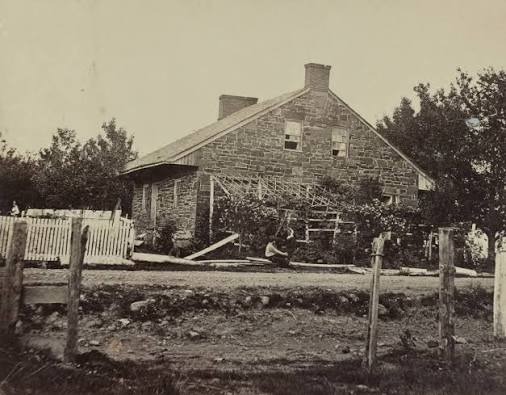
Today, the small stone house beside the Chambersburg Pike is known almost universally as Robert E. Lee’s Headquarters. That name makes Mary Thompson nearly disappear.
Yet Mary was the person who actually lived there. She was there when artillery thundered around the house on July 1, 1863. She watched Confederate soldiers take possession of the ridge outside her door. She later complained of robbery and destruction. And within months of the battle, people were already saying that Robert E. Lee had used her house.
Then things became complicated.
Confederate officers later insisted Lee had slept in a tent. A federal marker effectively endorsed their version. One quotation attributed to Lee appears to have no reliable source at all. The house burned. A later tenant was arrested for keeping what a Gettysburg newspaper called a “bawdy house.” Commercial owners surrounded the place with cabins, a motel, a restaurant, a swimming pool, and souvenirs.
Eventually, as happens in Gettysburg, ghosts arrived too.
The result is a place where nearly every layer of history comes with an argument attached.
Before Lee, there was Mary

The house itself probably dates not to 1779, as an old tradition suggested, but to about 1833 or 1834. Research into Gettysburg tax records found that owner Michael C. Clarkson’s assessment was altered in 1834 to note “one new house.” That fits the small, one-and-a-half-story stone structure still standing today far better than the older date sometimes associated with a marked foundation brick.
Mary Thompson was born Ann Marie Long near Littlestown in 1793. Her first husband, Daniel Sell, died in 1822 while Mary was pregnant with their third daughter. She later married Joshua F. Thompson and had five more children.
Joshua has not fared well in the historical record.
Modern histories often describe him simply as an alcoholic who abandoned his family. There is some real evidence behind that characterization, but it deserves more care. According to research cited by the American Battlefield Trust, Mary’s eldest daughter petitioned an Adams County court in 1841 to have Joshua declared an “habitual drunkard.”
That establishes that the accusation was made by the family. It does not, at least from the records presently located, establish exactly what the court decided. Nor has a divorce or legal-separation record surfaced. Joshua subsequently disappears from the local record used by researchers and was dead by March 1850.
Whatever had happened in the marriage, Mary was effectively on her own.
The way she came to possess her house is also unusual.
Clarkson fell into serious financial trouble, and his property was seized. At the resulting sheriff’s sale in the mid-1840s, the approximately three-acre tract containing the stone house was purchased for just $16 by Thaddeus Stevens, the Gettysburg attorney, congressman, and future Radical Republican leader.

But Stevens did not buy it as a Gettysburg residence for himself.
He bought it as trustee for Mary Thompson.
Exactly why he structured the transaction that way remains uncertain. Pennsylvania law still severely restricted married women’s independent control of property, and Mary was apparently estranged from Joshua. The arrangement may have protected her and her children. Whatever Stevens’s motives, there is no evidence that he ever lived in the house. Mary did.
And on July 1, 1863, the war came directly to her yard.
“Lee’s Headquarters”—maybe
The Thompson house stood along the Chambersburg Pike at Seminary Ridge, in the path of the fighting as Union troops fell back toward Gettysburg.
This was not a farmhouse somewhere behind the lines.
Union artillery operated close to the property. Infantry fought nearby. Soldiers retreated through the area. Confederate forces seized Seminary Ridge, and Lee’s command operation soon developed in Mary Thompson’s immediate neighborhood.
What happened next has generated more than a century of argument.
The earliest evidence actually favors the house.
A correspondent for the Lutheran and Missionary reportedly interviewed Mary Thompson in September 1863—less than three months after the battle—and recorded her saying Lee “occupied her house from Wednesday evening, July 1st, until Friday night.”
Within weeks of the battle, Matthew Brady’s photographic team also photographed the building and identified it as Lee’s Headquarters. Two of those views survive.
Then, in 1864, Gettysburg resident Michael Jacobs published an account saying Lee had selected the house after the Union retreat, had taken meals there, and had “lodged all night” when he was not elsewhere along the Confederate lines. Jacobs also recorded Mary complaining bitterly about the robbery and destruction of her property.
Those are unusually early sources.
But Confederate witnesses later told a different story.
Lee staff officer Walter H. Taylor explicitly said that Lee remained “under canvas and did not occupy the house.” Armistead Long remembered Lee’s headquarters bivouac among orchard trees. John D. Imboden described being taken to Lee late on July 3 and meeting him inside one of several headquarters tents.
Those accounts are real evidence too.
Gettysburg historian Henry S. Moyer gathered much of it into a 1911 pamphlet arguing that none of the buildings promoted as Lee headquarters had actually served that purpose.
Moyer also repeated a supposed statement by Lee:
“My headquarters were in tents, in an apple orchard, back of the Seminary, along the Chambersburg pike.”
There is a problem.
No reliable Lee document containing that statement has been found.
The quotation was later placed on a federal battlefield marker, giving it considerable authority, but the American Battlefield Trust now describes the attribution as spurious.
The government apparently institutionalized an already-circulating quotation rather than independently proving Lee had said it.
Moyer had another eyewitness story. He said an elderly woman living in the stone house told him Lee had never entered it.
That sounds compelling until the dates are examined.
Moyer’s visit apparently occurred in 1874.
Mary Thompson had died in 1873.
He could not later identify the woman.
Somewhere in the transmission of the story, an unidentified elderly resident became “Mrs. Thompson”—and therefore appeared to contradict Mary’s own reported 1863 statement.
The safest conclusion may be less dramatic than either side would prefer.
Lee indisputably maintained headquarters tents in the immediate area. His staff, couriers, guards, and command apparatus operated around the Thompson property. There is also unusually early evidence that Lee personally used Mary’s house, likely for meals and perhaps lodging, especially beginning July 1.
The property was part of Lee’s headquarters complex.
Exactly how Lee divided his time between the house, tents, and battlefield remains unsettled.
Bodies, bandages, and the problem with good stories
Other traditions surrounding the house are considerably shakier.
It has been said that the Thompson house became a hospital. Mary’s clothing and bedding were supposedly torn into bandages. Carpets were reportedly used to wrap corpses. Soldiers allegedly died inside. Bodies were supposedly buried outside.
All of this sounds completely plausible.
That does not make all of it documented.
Modern histories repeat many of these details, but the primary evidence behind them has proven surprisingly difficult to locate. Mary’s near-contemporary complaint about robbery and destruction is strong evidence that soldiers stripped or damaged the property. It does not prove every later story about carpets, sheets, wounded soldiers, or corpses.
Modern archaeology actually complicates the burial tradition.
During restoration of the property, investigators examined two stones that had been interpreted as possible grave markers. No human remains were found. Archaeology also failed to produce the kind of medical assemblage that might establish the property as a major surgical hospital. Only one definite Civil War military artifact—a Minié ball—was reported from the broader project area, some distance from the house.
That does not prove nobody was ever wounded, treated, killed, or temporarily buried there.
It does mean we should not say archaeology proved that they were.
Fire—and a “bawdy house”
Mary Thompson remained associated with the property until her death on May 25, 1873.
By 1888, Philip Hennig had purchased the house at auction for $740 and rented it to tenants.
Then, in September 1896, the house caught fire.
The interior suffered serious damage, but contemporary reports said the stone walls remained in good condition. Modern restoration later found fire-charred structural timbers still incorporated into the building. The house visitors see today is therefore neither perfectly untouched nor a twentieth-century replica. Much of the stone structure survived the fire, along with some historic timber, while other portions were repaired or altered.
Then came one of the stranger episodes in the building’s history.
In 1907 a tenant named Emaline or Emma Feister was arrested. The Gettysburg Compiler described the charge as keeping a “bawdy house” for fornication and disturbance of the neighborhood.

It is tempting to translate that immediately as: Lee’s Headquarters became a brothel.
The evidence does not quite get us there.
“Bawdy house” was a period legal term associated with disorderly houses, sexual activity, prostitution, and public nuisance. The charge certainly had a sexual element. But no disposition of Feister’s case has yet surfaced—no conviction, testimony, plea, sentence, or dismissal.
So we know she was arrested and accused.
We do not yet know exactly what was happening inside Mary Thompson’s old house.
And then came the ghosts
The building’s paranormal reputation is, ironically, much harder to document than its disputed military history.
Gettysburg’s modern ghost culture exploded in the late twentieth century, particularly after Mark Nesbitt began publishing his Ghosts of Gettysburg series in 1991. Stories now attached to historic buildings throughout town include apparitions, voices, footsteps, cold spots, lights, electronic voice phenomena, and spectral soldiers.
The Thompson House has become part of that supernatural Gettysburg.
Visitors and paranormal enthusiasts have associated the property with Confederate soldiers and, inevitably, with Mary Thompson herself.
Mark Nesbitt recounts a story of a soldier across the street from the Thompson house who lingered after being mistaken for dead, before dying, then remaining as an angry ghost.
The historical traditions beneath some of the ghost stories are hard to prove or disprove. If we cannot document that a soldier died in a particular room, we certainly cannot confidently identify his ghost there.
Perhaps the most interesting thing about the Thompson House is not whether it is haunted.
It is how perfectly the building demonstrates the way Gettysburg accumulates stories.
A widow lived there. Thaddeus Stevens helped secure the property for her. A battle erupted around it. Robert E. Lee almost certainly maintained his headquarters complex there and may well have eaten and slept inside the house. Veterans later disagreed about what happened. A government marker gave authority to a dubious quotation. The building caught fire. A tenant was arrested on a morals charge. Entrepreneurs turned the property into a museum, campground, restaurant, motel, swimming pool, and souvenir destination.
Eventually supernatural stories attached themselves to all the rest.
In 2015, the Civil War Trust—now the American Battlefield Trust—acquired the property. Nine later buildings were removed. Archaeologists and preservationists uncovered concealed basement windows, a second fireplace, and charred timbers surviving from the 1896 fire. Using Brady’s wartime photographs and other evidence, they reconstructed parts of the surrounding landscape, including fencing, garden features, an orchard, and even a small doghouse visible in the old photographs.
The result is quieter than the roadside attraction that once occupied the site.
And maybe more interesting.
Because Mary Thompson’s house does not need invented certainty.
Its actual history already contains an unhappy marriage, Thaddeus Stevens, a sheriff’s sale, battle, disputed testimony, questionable quotations, a destructive fire, a sex-related criminal charge, commercial mythology, archaeology, and ghosts.
Whether any of those ghosts are really there is for visitors to decide.
Leave a Reply