Lydia Leister (born Lydia Study) was born some time between 1808 and 1811 (depending on what source you read) in Carroll County, Maryland. She hailed from a large family: her father, Dr. John Martin Study, was a local physician, and one of her sisters, Catherine, later married Gettysburg farmer John Slyder. In 1830 Lydia wed James Leister, a Maryland native, in Pennsylvania. The young couple started a family, and over the years Lydia gave birth to at least seven children, including Angeline, James Jr., Eliza Jane, Amos, Daniel, Hannah, and Anna Matilda (some genealogical sources show more). Sadly, not all of the children survived to adulthood; by the late 1850s one daughter (Angeline) had died, leaving six living children. In the mid-19th century, the Leisters moved north to the Gettysburg area – likely around 1850 – seeking to be closer to Lydia’s extended family as James’s health declined. James worked to support his family at Francis Bream‘s Mill until the time of his death—period-era newspaper articles show him advertising for apprentices.

James Leister suffered from chronic illness (likely tuberculosis) and passed away on December 11, 1859, leaving Lydia a widow with their children to care for.
The death immediately plunged Lydia into hard times. A month later, she auctioned her husband’s finest tools in order to pay bills.

Less than two years after her husband’s death, Lydia seized an opportunity to establish her own home in Gettysburg. Using funds inherited from her father’s estate (held in trust until after James’s passing), she purchased a small farm just south of town. On March 30, 1861, the widow Leister bought a 9-acre farm on Taneytown Road from Henry Bishop, Sr. for the sum of $900. (According to Adams County deed records, the land had originally been owned by Thomas Nolan and then by Bishop since 1840.) This purchase made Lydia the proprietor of a modest homestead in Cumberland Township, on the outskirts of Gettysburg.
The Leister Farm on Cemetery Ridge
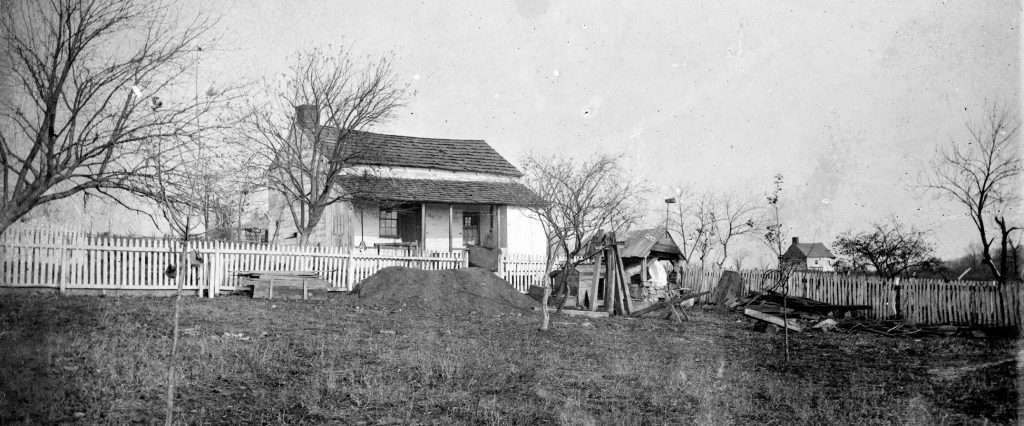
Lydia’s newly acquired farm occupied a strategic spot just south of Gettysburg, along the Taneytown Road near the base of Cemetery Ridge. The property included a modest one-and-a-half story log cottage – essentially a wooden two-room house measuring only about 390 square feet, with a floored attic above. The house had a kitchen and a small sitting/bedroom on the ground floor, and a shaded porch on its south side. Though small, the farm was productive. It featured a little hayfield, several young apple and peach trees, a spring for water, and a log barn that Bishop had built years earlier. Lydia worked hard to sustain her family here, growing crops such as wheat and tending to a few farm animals. Town tax rolls and agricultural records of the early 1860s would likely show Lydia Leister as the head of this humble household, a rare position for a woman at the time.
By 1863, Lydia was about 52 years old and living on the farm with the younger half of her children. The 1860 U.S. census for the area listed three adults and three children in her household. Those adults were Lydia herself, her eldest son James Leister Jr. (who had not yet enlisted for military service in 1860), and her next-oldest son Amos, who at age 18 helped run the farm. The remaining minors were Daniel, Hannah, and Anna Matilda. (By the time of the battle in July 1863, James Jr. was off serving in the Union army and Lydia’s daughter Eliza Jane had married and moved out, leaving Amos, Daniel, and the two youngest girls at home.) It was a bustling household, but one of modest means. Lydia paid her Cumberland Township taxes and likely pinched pennies to pay off the remainder of the mortgage on her property – as she later recalled, “I owed a little on my land yit” even in mid-1863. Still, by all accounts she managed a self-sufficient farm and provided for her family in the years leading up to the Civil War.
The Battle of Gettysburg: Headquarters on the Farm
In the summer of 1863, war came literally to Lydia Leister’s doorstep. Gettysburg’s location at the hub of several major roads had put the town in the crosshairs of two armies. On July 1, as fighting erupted northwest of town, Union officers rode along the Taneytown Road and warned civilians to evacuate. Lydia was advised by a mounted Union officer that her farm lay in harm’s way, and she wisely decided to flee with her children. Hastily gathering a few belongings, Lydia departed on July 1 with her two youngest daughters (Hannah and Matilda) and perhaps other family members, seeking refuge about 13 miles south at her brother David Study’s home in Taneytown, Maryland. She left behind her home and farm animals, not knowing what would remain when she returned.
Lydia’s property was soon swept up into the Union Army’s defensive position. By July 2, the Union Army of the Potomac had formed a formidable line along Cemetery Ridge, and General George G. Meade, the army’s commander, arrived to establish his field headquarters. Meade selected the Leister cottage as his headquarters due to its central location just behind the Union lines. The tiny farmhouse – “little more than a hut,” one officer described – became the nerve center of the Union army. On the night of July 2, General Meade convened a council of war in Lydia’s front room, crowding a dozen generals into the cramped space to decide whether the army should stand and fight or retreat after two brutal days of battle. The next day, July 3, the Leister farmstead was at the epicenter of action. Around 1 p.m., a massive Confederate artillery bombardment preceding Pickett’s Charge rained shells onto Cemetery Ridge – and many of those overshot rounds crashed into the area around Meade’s headquarters. Exploding shells tore through the yard and buildings: one round smashed through the cottage roof and another struck inside a room, blasting apart Lydia’s furniture and knocking down the porch supports. Union staff officers sought cover where they could. “The sight around Meade’s headquarters…was terrible,” remembered local teenager Daniel Skelly, who later counted at least a dozen or more dead horses strewn around the Leister yard. In fact, as many as 17 horses were killed on the property during the cannonade and charge. Meade himself was forced to relocate his command post briefly when the shelling grew intense, moving to a safer spot to the rear (and then to a nearby barn) as his shot-torn staff sought shelter. By the end of that fateful afternoon – after Pickett’s Charge had been repulsed in front of Cemetery Ridge – Lydia Leister’s little farm had witnessed the climax of the Battle of Gettysburg. It had served as the battlefield HQ of a Union general and endured the full fury of combat.
Return to a Devastated Farm

When the fighting ceased and the Confederate army retreated, Lydia Leister hurried home only to discover a scene of ruin. She returned to her farm on July 4 or 5, 1863, to find her property ravaged by war. A photograph taken shortly after the battle shows the Leister house amid a landscape of devastation, its walls pockmarked and surroundings littered with debris. The once tidy farm was “in ruins,” as one account described: the house was punctured by shot holes, its roof and porch damaged by artillery blasts. Inside, Lydia found her meager household goods in shambles. Her furniture had been smashed – a bedstead was “knocked…to pieces” by a shell – and the bedding was soaked with blood from wounded soldiers who had been treated there. Almost nothing of value remained. Other items had been carried off, and all the family’s food stores were gone save for a little flour and lard that Lydia had hidden under a bench. Every fence rail on the property had been torn down and used for firewood, leaving not a single fence standing. The summer crops she had hoped to harvest (including two lots of wheat she had sown) were trampled into the dirt, yielding “nothing” for that year. Her small barn had been emptied – about two tons of hay had been fed to army horses or destroyed. Worse still, dead soldiers and horses lay across her land. “There was seventeen dead horses on my land,” Lydia later recalled of her grim homecoming. The carcasses had contaminated her water sources: the spring was spoiled by decomposing animals, “poisoning” the water so badly that Lydia eventually had to dig a new well. Even her small orchard suffered; five dead horses had been burned around her best peach tree, killing it, and her young apple trees were broken down.
Faced with this devastation, Lydia did what many Gettysburg civilians had to do – she set about rebuilding from scratch. The resilient widow and her children toiled to make the home habitable again. They buried or disposed of rotting carcasses and cleaned bloodstains from the floors. In an example of practical recovery, Lydia gathered the remains of the fallen horses and sold 750 pounds of bones to a fertilizer plant for about fifty cents per hundredweight. (It took over 18 months for the horse carcasses to decompose enough that only bones remained to be collected.) These bone sales yielded only a few dollars – one of the few forms of compensation she would ever receive. Later, Lydia filed official damage claims with the U.S. government for the destruction of her property, totaling $1,311 in losses, but the War Department eventually settled and paid her a mere $52.50. Like most Gettysburg residents, Lydia got only a token reimbursement for her wartime losses. Nonetheless, she persevered: “Yet, she stayed and worked to make her home habitable once again,” noted one historian of her determination.
Contemporary observers took note of Lydia Leister’s plight and perspective in the battle’s aftermath. In 1865, journalist John T. Trowbridge visited the Leister farm and found Lydia – “a barefooted woman…with a strong German accent” – drawing water from her newly dug well. He interviewed the widow about her experiences and found her understandably fixated on her personal hardships. “This poor woman’s entire interest in the great battle was, I found, centered in her own losses,” Trowbridge wrote; whether the country lost or gained, “she did not know or care.” Lydia’s story, as told by Trowbridge, came to exemplify the Civil War’s impact on ordinary civilians – her concern was not with glory or politics but with the very real struggle to rebuild her life.
Rebuilding, Family, and Postwar Years
In the years after 1863, Lydia Leister managed not only to recover but to modestly improve her lot. With help from her grown sons (James Jr. safely returned from the army, and Amos and Daniel now reaching adulthood), she repaired the war damage and even expanded the farmhouse. Around the late 1860s, they added a second story to the little cottage, transforming it from a “hut” into a two-floor dwelling to better accommodate the family. Lydia also acquired additional land: she purchased a few more acres from her neighbor Peter Frey to enlarge the farm. Over time the Leister farm grew to roughly 18 acres, and the hard-working widow regained a measure of prosperity.
The Leister children began to establish lives of their own as well. Son James Leister Jr., after surviving his wartime service, finally came home and likely assisted on the farm before moving on. Amos and Daniel also helped run the expanded farm through the 1860s and 1870s. Daughters Hannah and Matilda, who had been little girls during the battle, grew up in Gettysburg; one or both may have married or left the farm as adults (historical records suggest Matilda never married and stayed by her mother’s side, while Hannah’s later life is less documented). Meanwhile, Lydia proved to be a shrewd survivor. She occasionally benefited from the battlefield’s notoriety: once, she sold the small table from her house (the very table General Meade had used for his maps and notes) to a visiting collector for a good price. That table later made its way into the Gettysburg museum collections, demonstrating how even Lydia’s humble belongings became historic artifacts.
By the late 1880s, age and hard work had taken a toll on Lydia’s health. Maintaining the farm was becoming difficult. In 1888, at roughly 79 years old, Lydia decided to sell her house. She found a willing buyer in the Gettysburg Battlefield Memorial Association, a preservation group dedicated to saving portions of the battlefield. In May 1888 the Association purchased the Leister farm for $3,000 – a generous sum that gave Lydia a decent profit, considering she had bought it for $900 nearly three decades earlier. One condition of the sale was that Lydia could take her cherished house addition with her. Before turning over the property, she had the entire two-story addition (which her family had built post-war) carefully dismantled and moved into town. Lydia relocated to a new home on the Emmitsburg Road at Gettysburg’s edge, where the salvaged addition was reassembled as part of her new house. (That dwelling still stands today, known as the Gettystown Inn near the historic Dobbin House on Steinwehr Avenue.) Lydia lived out her final years in her town house, cared for by family. She passed away on December 29, 1893. The widowed farm owner who had weathered one of America’s greatest battles was laid to rest in Gettysburg’s Evergreen Cemetery, not far from the very ground she had farmed and the town she had helped rebuild.
Legacy and Preservation of the Leister Farm
Lydia Leister’s little farm – once a backdrop to history – has been preserved as an enduring piece of the Gettysburg landscape. A modern view of the Leister farmhouse, fully restored, shows the small white cottage as it appears today within Gettysburg National Military Park. After Lydia sold the property, the Gettysburg Battlefield Memorial Association (GBMA) kept the site largely intact due to its historical significance as General Meade’s Headquarters. The GBMA (sometimes called the Battlefield Preservation Association) leased the farm to local tenant farmers for many years, so the house continued to be lived in and the land cultivated into the 1910s and 1920s. In 1895, Gettysburg officially became a national military park, and within a few decades the U.S. War Department took over stewardship of all battlefield lands, including the Leister farm. Finally, in 1933, the National Park Service assumed management of Gettysburg National Military Park and with it the Leister property. At that point the old farmhouse ceased to be a residence; the Park Service used the buildings for storage while beginning plans to interpret and restore the site.
Twentieth-century preservation efforts ensured that the Leister house would survive for future generations. In the early 1960s, the NPS stabilized the aging structure – excavating and reinforcing the foundation in 1961 – and then undertook a comprehensive restoration in 1966. The goal was to return the cottage to its 1863 appearance (minus the removed second-story addition) so visitors could appreciate its humble scale and significance. Today the house and a rebuilt barn stand on their original foundations along Taneytown Road, looking much as they did in the Civil War era. The National Park Service maintains the Leister farmstead as a key historic site. Thousands of visitors each year stop at “Meade’s Headquarters” to peer through the windows of the tiny log cottage. Inside, the rooms are staged simply, evoking the night of July 2, 1863 when oil lamps lit a council of war in a civilian’s parlor. A small wayside marker identifies the house and honors Lydia Leister’s experience. In addition, historians and writers have made sure Lydia’s personal story is not forgotten. Local archives (such as the Adams County Historical Society) preserve her estate records, will, and wartime claim files, which offer a paper trail of a life interrupted by war. Popular accounts of Gettysburg often mention Lydia as a symbol of the battle’s impact on civilians – her home instantly transformed into a headquarters and hospital, her livelihood wrecked, and her steadfast recovery afterward. One modern author noted that her “little hut has earned its place in history as most likely the smallest house used as a headquarters for any wartime general”. Indeed, Lydia’s legacy endures in both the preserved landscape of Gettysburg and in the narrative of civilian resilience.
Leave a Reply