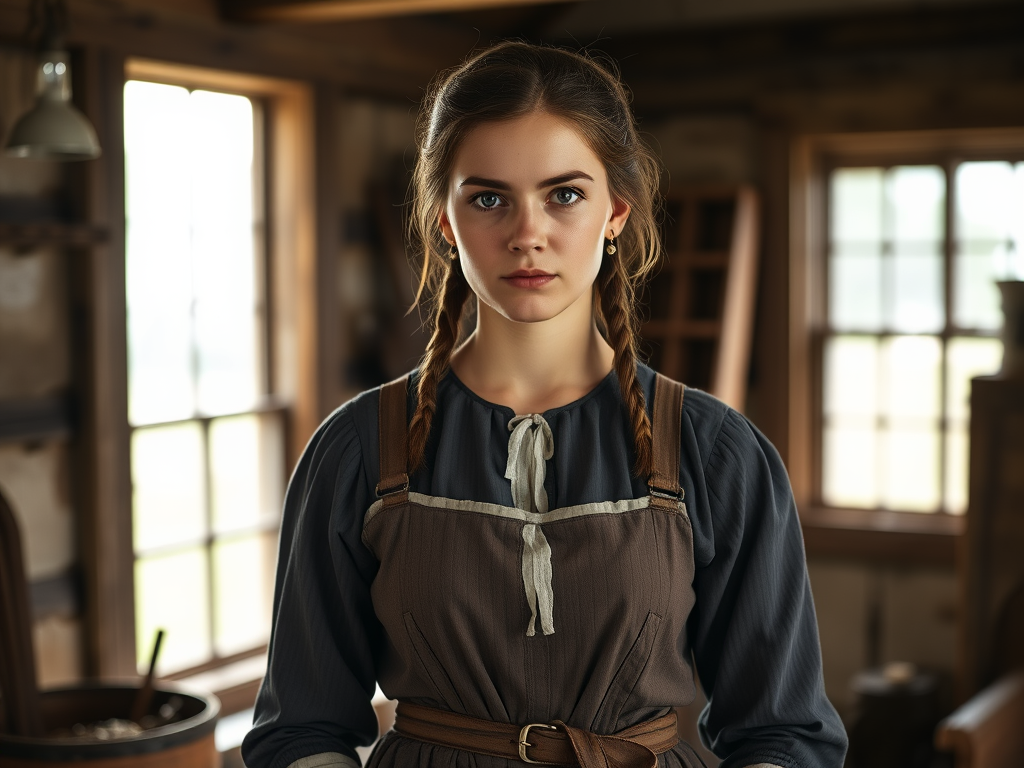
The 1869 court case brought by Caroline Shenabrook may have been a landmark moment in the decline of Isadore Keefer. It remains a powerful illustration of the function of law in this era in dealing with “moral offenses.” But who was Caroline Shenabrook and what became of her after the case?

Caroline “Carrie” Shenabrook was born around 1840 in Adams County. The 1860 census captures her at age 20, living at home in rural Hamilton Township (east of Gettysburg). Her father, Thomas Shanebrook (their last name varies in spelling across many publications), was a 49-year-old farmer, and her mother Mary was 47. Caroline (listed as “Carolina” in the census) had a 19-year-old brother John at home as well. The Shanabrooks were typical mid-century farming folk of modest means. Like many young women of her station, Caroline likely contributed to the household – perhaps doing dairy work, sewing, or domestic chores – and had limited formal education. She was unmarried and, so far as the record shows, did not leave home during the Civil War years. Hamilton Township, though just a few miles from Gettysburg, was spared the direct devastation of the 1863 battle, but the war’s effects – inflated prices, disrupted markets, and local men away in the army – would have been felt in her community.

Caroline’s life took a dramatic turn in the early 1860s, when she became pregnant out of wedlock . . . but not with Isadore Keefer’s baby. No, in this case, her child appears to have been with a man named John Wolford. How do we know? Two big clues. In the 1880 Census, Caroline still has her surname but also has three sons . . . with Wolford as the last name.

Much later in life, Andrew’s death certificate indicated that his mother was Caroline and his father was John Wolford.

Who was John Wolford? We’ll cover him in a separate post, but for here, we’ll say that he appears to have been a single man living in Adams County who came from a large family of Wolfords. He served in the army late in the war, joining in 1864 and seeing little combat.
The 1880 Census makes clear that Caroline had Andrew in roughly 1864, Daniel in roughly 1866, and William in roughly 1868. In April 1869, Caroline took the courageous (and likely humiliating) step of bringing Isadore Keefer to court. We know from the Quarter Sessions records that the indictment charged him with adultery (given his existing marriage) and with fornication & bastardy with Caroline. Caroline would have had to testify to the liaison in open court, enduring the scrutiny of male judges, jurors, and spectators. The not-guilty verdict on adultery spared Isadore a heavier moral stain, but the guilty verdict on bastardy publicly affirmed Caroline’s claim and entitled her to financial support for the child. The court ordered Isadore to pay for the child’s maintenance – a critical outcome for Caroline, who otherwise might have literally had to enter the poorhouse to have her baby. Indeed, in some 19th-century cases, if the father could not or did not pay, the child and mother could be sent to the almshouse (where, ironically, Isadore himself later died). Thankfully for Caroline, the legal process worked: Isadore was held accountable, at least on paper.
Given that the case took place in 1869, it might seem like William was the child, but took John Wolford’s surname . . . except that, years later in 1888, a young woman named Annie Keefer submitted her marriage application with John Sharp and listed Isadore as her father and Caroline as her mother.

Who raised Annie? The record is unclear. She’s not in the 1870 Census in the Keefer home, nor is there an obvious Census record in 1870 for Caroline, nor is Annie living with Caroline in 1880. We cover Annie and what happened to her in a separate post.

Whatever the case, Caroline’s life did not get a lot easier after the court case. The 1880 Census shows that she and all three of her sons were “laboring” or “laborers.” What would this have meant in the era?
As a female laborer in 1880 with no spouse and three sons to support, Caroline likely took whatever work she could find. Common options for women in her situation included:
- Washing and ironing clothes for neighbors (often called “washerwoman” or “laundress”)
- Cleaning houses or businesses in town
- Harvesting, weeding, or picking produce during farm seasons (especially near Gettysburg’s orchards and vegetable farms)
- Almshouse or borough cleaning contracts, including privy emptying or sanitation work, occasionally subcontracted to the poor
Although the census doesn’t specify “domestic servant,” the broader term “laborer” often lumped such work in for lower-class women.
The boys were likely doing youth labor, which could include:
- Farm hands: milking, mucking stalls, harvesting crops, hauling wood or water
- Stable boys: caring for horses, cleaning barns in town or on surrounding properties
- Errand runners or apprentices: delivering goods for grocers, butchers, or dry goods stores
- Railroad or freight work: loading/unloading at nearby stations
- Cigar factories or tanneries (if within walking distance)
Even 12-year-olds were frequently put to work in this era, especially when fatherless and poor. It was not uncommon for such children to work full days and attend school sporadically or not at all.
These were all challenging ways to live and make ends meet. Beyond this, we know little of what else happened to Caroline. We’ve not yet found an entry for her grave or a record of her passing. Regardless, her raising of her three boys, her relationships outside of marriage, her providing for herself were all different from the norms of the time.
Leave a Reply